Monday, March 06, 2006

Submitted This Day: Structure of DNA


Image from HERE.

From Today In Science History:

Today in 1953, Watson and Crick submitted to the journal Nature their first article on the structure of DNA, ”Molecular Structure of Nucleic Acids: A structure for deoxyribose nucleic acid”, which was published on April 25.
"We wish to put forward a radically different structure for the salt of deoxyribose nucleic acid. This structure has two helical chains each coiled around the same axis... Both chains follow right-handed helices... The novel feature of the structure is the manner in which the two chains are held together by purine and pyrimidine bases... They are joined together in pairs, a single base from one chain being hydrogen-bonded to a single base from the other chain, so that the two lie side by side with identical z-co-ordinates. One of the pair must be a purine and the other a pyrimidine in order for bonding to occur."

Sunday, March 05, 2006

Nessie Is A Jumbo Dumbo


Nessie from HERE.

From the Glasgow Sunday Mail :

Scotland’s top dinosaur expert has stunned the science world by claiming the Loch Ness Monster is an elephant. Palaeontologist Dr Neil Clark thinks the Nessie myth is "a magnificent piece of marketing" thought up by a 1930s circus boss.

Dr Clark says unexplained photos of Nessie could be of the trunk, head and back of a swimming elephant. He claims the phenomenon may have been started by circus impresario Bertram Mills in 1933 after he saw one of his elephants bathing in Loch Ness.

Mills, who died in 1938, offered £20,000 to anyone who could capture the Loch Ness Monster for his circus, sparking international interest. Clark - who spent two years investigating the unexplained sightings - said: "Nessie as we know it today is largely a product of the 20th century.

Mars Needs Bikinis


Art © Tom Bagley

Now really, what’s going to get your attention – a headline like “Mars Needs Bikinis” or “ALBERTA PALAEONTOLOGICAL SOCIETY 2006 SYMPOSIUM” to be held in Calgary, Alberta, on March 18th?

Go to their website for more information. I’ll be there, this time presenting a poster looking at the validity of Nanotyrannus with my co-authors Larry Witmer and Eric Snively.

And since I’ll be in Calgary that’s as good as excuse as any to once again plug the art of the very talented Tom Bagley. I’ve just found out that Tom and six other artistic conspirators have their own shared blog, “7 Deadly Sinners”, which is great fun to cruise around. So why hasn’t the usually ahead of the curve "Drawn!" not featured this site yet?

The ‘sinners’ even feature links to this very blog (thanks!) and others like genius cartoonist Carol Lay (Hi Carol!).

For more great art that you’ll usually see stapled to a lamppost (at least the old wooden ones) go visit Gigposters.com.

Saturday, March 04, 2006

New Fossil Snakes From Australia

From seven.com.au:
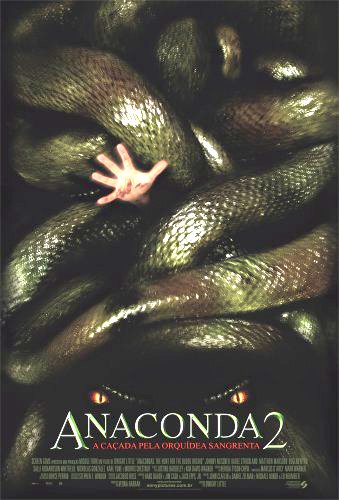
Snake fossils up to 25 million years old unearthed in north-west Queensland strongly suggest snakes evolved from lizards, says Palaeontologist John Scanlon.
Scanlon said the bones in the jaws and faces of the two large snakes, which were well preserved in limestone in the Riversleigh world heritage area near Mount Isa, were closer to those of lizards than modern snakes.

The two snakes were part of the Madtsoiid branch of the snake family that "split off" about 95 million years ago, said Dr Scanlon, who works at the Riversleigh Fossils Centre at Mount Isa. "The way the upper jaws are connected to the brain case and the structure of the ear region ... supports their origin from goanna-like lizards."

He said the snakes, which were almost five and six metres long, were part of a species that died out in Australia about 50,000 years ago. "They died out about 40 million years ago outside of Australia but because the country is isolated, it became like this lost world," Dr Scanlon said.

He said the Madtsoiid snakes were not venomous and are not closely related to any modern species of snakes.

Ohio Paleo Helps Find 45 Million Yr Old Croc In India

From The Times of India:

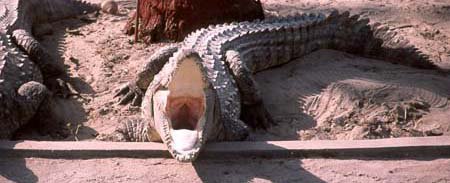
In a rare discovery last week, a team from the earth sciences department of IIT, Roorkee in Uttaranchal, along with an American researcher, found a 45 million-year-old fossil of a crocodile in Julrai village in Lakhpat taluka of Kutch district.


Croc pic from HERE.

According to palaeontologist Sunil Bajpai, associate professor in the department, the crocodile skull that the team found is about 70 cm long, suggesting that the body must have been about eight to 10 metre long.

In the past couple of years, the team has also discovered an assemblage of fossil land mammals from a coal (lignite) mine at Vastan near Surat. The collection includes distant ancestors of modern horses, humans, deer and cattle, bats, insectivores and many more groups.

PhD scholar Debasis Das — part of the team comprising Hans Thewissen, professor of Anatomy at North-eastern Ohio University's College of Medicine — found the crocodile fossil which has been gifted to Kutch Sanskriti Darshan museum.

Bajpai said "We have also found molar teeth for the first time in India that suggest the presence of animals related to kangaroos in India approximately 52 million years ago".

Kong's Chinese Box Office


Hey Kids! More Kong art © Pete Von Sholly!

From Sina English:

Big budget epic "King Kong" has generated 100.3 million yuan (about 12.5 million U.S. dollars) on the Chinese mainland, becoming the box office king among imported films in the past five years.

Peter Jackson's remake of the great-ape adventure took in over one million yuan last weekend, which brought its total box office to 100.3 million yuan since its release in the Chinese mainland on Jan. 12, a source with the film's distributor in China, the Huaxia Film Distribution Co., Ltd said on Tuesday.

" King Kong," with a 207 million US budget and 540 million US in global box office revenues, has received four 2006 Oscar's nominees-- Art Direction, Sound Mixing, Sound Editing and Visual Effects.

"Titanic" still holds the record of China's box office with 320 million yuan(some 40 million U.S. dollars).

Liu Shusen, vice president of the Huaxia, said they imported "King Kong" for its high artistic quality and production level and it can benefit home-made films. The overseas box office result was also a factor, he said.

"King Kong" holds the common interest of all people, so I believe it can strike the chord with Chinese audiences likewise," Liu said.

Dapingfangornis, New Fossil Bird Part 2

From The People’s Daily On-line:

Dr. Li Li from the Institute of Mesozoic Paleontology of Western Liaoning of the Shenyang Normal University and her colleagues discovered the fossil about 16 meters underground. The well-preserved remains include a complete skeleton with a skull. The total length of the bird fossil is 216 mm and its head is 28 mm with a high crista, said Li, adding the bird was named as Dapingfangornis after the place where it was found.

The long tail feathers of the bird indicated it was male and its toothed jaws and strong ungula feet proved that it was small and carnivorous, said Li. In addition, many fragmentary skeletons of fish and small reptiles were preserved under the feet of the Dapingfangornis, indicating that the bird liked eating animals alive, said Li.

Li's findings have been published in the February English version of Acta Geologica Sinica, a monthly by the Geological Society of China.

NOTE: I've added Acta Geologica Sinica to the journal list at the right.

Friday, March 03, 2006

New Fossil Bird Species Found

From the Shanghai Daily:
The remains of a new species of 100-million-year-old bird have been found in a fossil-rich area of northeastern China's Liaoning Province.
"The bird is different from other known birds of the Mesozoic in the medium- to small-size range with a distinct thorn-like process on its nose, which has never been found among other known fossil birds," said Dr Li Li from the Institute of Mesozoic Paleontology of Western Liaoning at Shenyang Normal University.

Li and her colleagues unearthed the fossil last October at Dapingfang in the west of Liaoning where the remains of dinosaurs, fish and early bird species have also been found.

The well-preserved remains include a complete skeleton with a skull. The total length of the bird fossil is 216 millimeters, said Li.

NB: When I find out more info I'll post it ASAP.

Star-Spangled Dinosaurs


© Pete Von Sholly

More fun stuff from Pete Von Sholly!

NOTE: The cool 'Space Thing' figure I mentioned HERE was sculpted by Pete's talented wife, Andrea, and is available NOW in better shops everywhere, or you can order it HERE.

Largest, Oldest Female Adapted To Cold

From Bruce Bower at Science News:
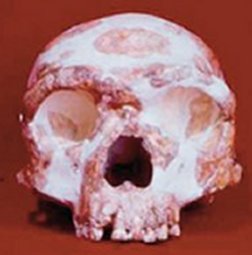
A 260,000-year-old partial skeleton excavated in northwestern China 22 years ago represents our largest known female ancestor, according to a new analysis of the individual's extensive remains.
This ancient woman puts a modern twist on Stone Age human evolution, say Karen R. Rosenberg of the University of Delaware. The fossil individual's large size and the apparent adaptation of her body to cold conditions are "consistent with the idea that patterns of human anatomical variation that we see today have deep evolutionary roots," Rosenberg asserts.

Although the woman belonged to the Homo genus, her species is uncertain. Now known as the Jinniushan specimen, she stood roughly 5 feet, 5-1/2 inches tall and tipped the scales at 173 pounds, the three anthropologists estimate. The only Stone Age Homo woman known to have approached that size weighed an estimated 163 pounds. Her partial skeleton came from a 100,000-year-old Neandertal site in France.

The Jinniushan specimen's size reflects her membership in a population that, as an adaptation for retaining heat in a cold climate, evolved large, broad bodies with short limbs, a shape similar to that of near-polar populations today. The work will be published in an upcoming issue of the Proceedings of the National Academy of Sciences.

The large estimated brain size of the Chinese fossil supports a current theory of mid–Stone Age brain expansion in Homo species, the researchers say. Earlier analyses of other fossils' skulls and lower-body bones—not including multiple bones from single individuals—had indicated that, between 1 million and 200,000 years ago, the Homo lineage peaked in body size and displayed considerable brain growth relative to body size.

Thursday, March 02, 2006

Debuted This Day (1933): King Kong


Read all about it HERE.

Born This Day: Willis O’Brien


March 2, 1886 - November 8, 1962

“O’Bie” was the special effects wizard best known to the world as the man who created King Kong. Read about him HERE.

Wednesday, March 01, 2006

Spiders In Amber

Comparing amber fossil assemblages across the Cenozoic. 2006, David Penney, and A. Mark Langan.
Scientists have carried out the first comparative scientific study of ancient spiders trapped in amber more than 30 millions years ago.

Giant Spider menacing the Parliment Buildings, Ottawa, Canada, from HERE.

The study of fossilised spiders from the Baltic (Poland) and the Dominican (Caribbean) regions has revealed new insights into the ecologies of spiders dating back to the Cenozoic period.

671 species of spiders were compared in the study of ancient spiders from different parts of the world. Dr David Penney analysed the size distributions of the spiders and comparing the distinct hunting traits of each species. He found that web-spinning spiders were bigger in Baltic amber than in Dominican amber, but that there was no difference between hunting spiders in either region. It was also found the fauna of the amber producing trees in each region accounted for this difference in size.

"Several lines of evidence show that greater structural complexity of Baltic compared to Dominican amber trees explains the presence of larger web-spinners. The Dominican trees are long, thin and smooth whereas the Baltic trees are wide and bushy, providing a much better environment for web-spinners to prosper," says Dr Penney.

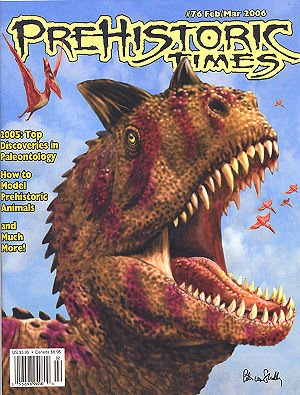
Pete's Prehistoric Times


Artist Pete Von Sholly has been burning up his drawing table recently, having produced the above cover for the current issue of Prehistoric Times.

And, although it’s not palaeo, I can't help but point out that Pete’s illo for his faux-Aurora model kit box of the “The Thing (from Another World) is so cool that someone (DHC) is putting out a real statue based on it!


Monday, February 27, 2006

Chasmosaurus CMN 8801


photo © M. Ryan

The nose of CMN 8801 photographed while I've been working at the Canadian Museum of Nature in Gatineau, QC, recently.

The Canadian Museum of Nature (CMN; in french it's called Musée Canadien de la Nature) used to be called the 'National Museum of Canada' and houses Canada's federal collection of fossils, including dozens of types of various dinosaurs. The Powers That Be tell me that the proper way to list a CMN specimen number in a publication is to use 'CMN' not 'NMC'; hence the above specimen is 'CMN 8801' not 'NMC 8801'.

Back when all the fossils were part of the Geological Survey of Canada all the specimens used 'GCS', and you'll see that in older publications.

Everything, The Universe and Life

From UC Davis:

If the history of life were to play out again from the beginning, it would have a similar plot and outcomes, although with a different cast and timing, argues UC Davis paleontologist Geerat Vermeij in the new paper, Historical contingency and the purported uniqueness of evolutionary innovations, in the Proceedings of the National Academy of Sciences.
Evolution at this level, like the rest of history, is predictable, perhaps more predictable than people want to imagine," Vermeij (below) said. "Many traits are so advantageous under so many circumstances that you are likely to see the same things again and again.

Vermeij's view contrasts with that put forward by the late Stephen Jay Gould and others, who argued that the history of life is so dependent on improbable events and includes so many possible paths that the chances of repetition are vanishingly small. Vermeij argues that some innovations, such as photosynthesis, plant seeds, mineralized bones and even human language are just such good ideas that they would reappear, although at different times and in somewhat different forms.

Vermeij reviewed 23 evolutionary innovations thought to be unique, including the genetic code, sex, human language and feathers, and another 55 that turn up repeatedly. Most of the unique innovations -- with the exception of human language -- are ancient, more than half a billion years old. Many of the repeated innovations are known only from a few specimens that were part of much larger groups. Vermeij said that many of life's "unique" developments might just appear to be so because other species died out and were not preserved as fossils.

A "unique" innovation might also be the result of intense natural selection. For example, once the genetic code appeared, primitive organisms readily swapped genes, as bacteria still do today. Any variants or competitors to the genetic code that arose later would have been unable to spread and establish.

Sunday, February 26, 2006

Rand McNally's Dinosaur World


Here's a not-quite-perfect photo of an artifact from my childhood, still hanging proudly in my parents basement. I suspect that this puzzle must have been associated with some other publication that Rand McNally put out but I've yet to find any reference to it. If anyone has any more info about it please drop me a line.

Argentinian Fossils Seized From Tucson Gem Show

From the Free New Mexican:

Federal agents seized three fossil dinosaur eggs, each the size of a small watermelon, and some 14,000 lbs of other fossils during the Tucson Gem, Mineral and Fossil Showcase this month after authorities determined the cache may have been smuggled illegally out of Argentina.

Immigration and Customs Enforcement agents began investigating after receiving a tip from Interpol suggesting that an exhibitor, the Rhodo Co., may have been selling fossils belonging to the Argentine government.

The company's Web site bills it as a supplier of Argentinean rhodocrosite, a pink mineral often used in jewelry, decorative bowls and other items. Customs agents acting undercover took digital photos of the fossils and conferred with paleontologists from Argentina. Interpol said the fossils probably came from Argentina and had significant scientific value.

No arrests have been made, Customs Supervisory Special Agent Lisa Fairchild said.

Saturday, February 25, 2006

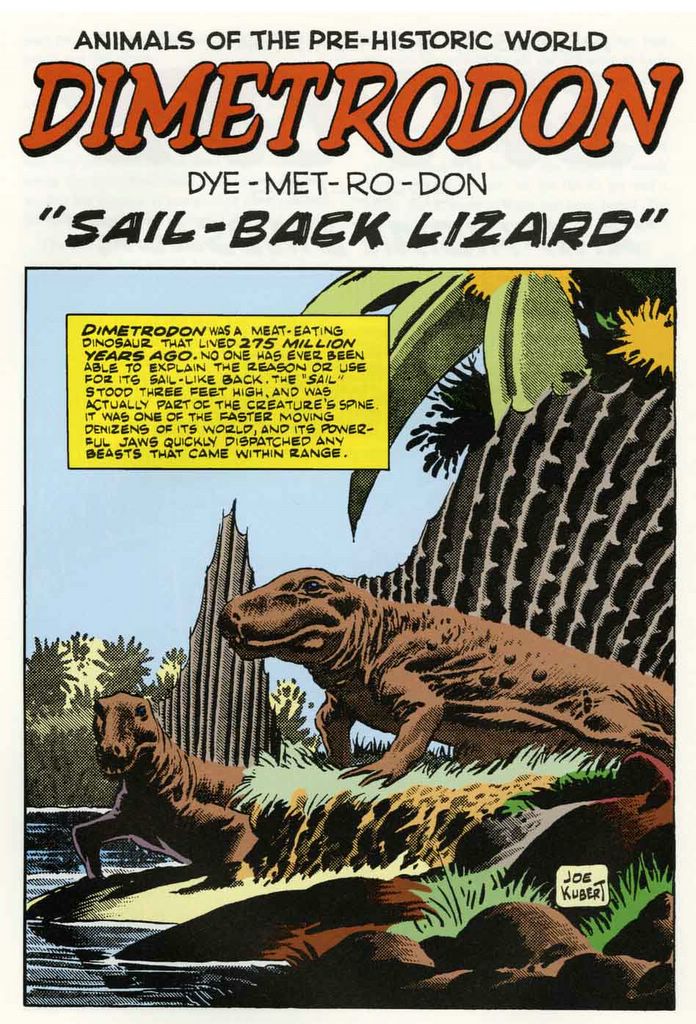
Tor's Dimetrodon


Tor and art © Joe Kubert. Click to enlarge.

Another fun page from Joe Kubert's 'Tor'.

Friday, February 24, 2006

The Behaviour of Sabre-Toothed Cats

Inferred behaviour and ecology of the primitive sabre-toothed cat Paramachairodus ogygia (Felidae, Machairodontinae) from the Late Miocene of Spain. 2006. M. J. Salesa et al. Journal of Zoology Vol268: 243


© Frank Frazetta

From the abstract: The Late Miocene (Late Vallesian, MN 10, about 9 Mya) carnivore trap of Batallones-1 (Madrid, Spain) has yielded a large sample of two species of sabre-toothed cats: the puma-sized Paramachairodus ogygia and the tiger-sized Machairodus aphanistus.

Results suggest that P. ogygia was a solitary felid with a low sexual dimorphism index, which in turn indicates low competition between males for access to females, and some degree of tolerance between adults, so that young adults were allowed to share the territory of their mothers for some time after maturity. The machairodont adaptations of P. ogygia indicate that this species was able to subdue and kill prey in less time than pantherines do, thus minimizing the risk of injury and the energetic costs of this action.