Saturday, January 14, 2006

I Discovered GorGilla!

Well, not me personally, but Jack Kirby did (with some inking help from Steve Ditko) in Tales To Astonish #12 (1960) – reprinted in Monsters On The Prowl #9 (1971).


Art by Jack Kirby, © Marvel Comics.

Notice anything familiar? Like a giant 'gorilla' vs. a T. rex? Which reminds me of a problem even I noticed with the Carl Denham character in the original King Kong movie when I was 6 years old. But I’ll let Bob from the Kirby Comics Blog pick up the story:
"Anyway, this story involves a group of scientists tracking down rumours of the missing link between apes and men in the mountains of Borneo. They succeed beyond all expectations when they find a living example in Gorgilla, but decide to leave him there when he saves them from a dinosaur also on the island, seemingly sensing his distant kinship with the humans. Y'know, the dinosaur would seem to be an even greater find than the missing link, and is just lying there dead for the taking, but I guess these guys specialize and have trouble seeing beyond their field (and I just realized that's a bit of a flaw in KING KONG. You find an island with a large ape and with dinosaurs, and you make a big fuss about the ape?)."
Thanks to Bob for letting me swipe this fun story from his blog!

Also: Thanks to sharp-eyed Lisa Z. in Calgary (former student and now proud Mom of two) for pointing out that GorGilla has a tail and could therefore only be a link between monkeys and apes, but not apes and humans!

Canadian Fossil Smuggler Jailed In China

From CTV.ca comes this news report:
A Canadian academic was sentenced to seven years in a Chinese jail Thursday after being found guilty of heading a smuggling operation trafficking nearly 3,000 dinosaur fossils within China and abroad.
Zhu Chunlin, 46, and five others were caught by customs officials in the southeastern city of Jinhua in November. The inspectors found 1,141 fossils they were trying to get out of China and another 1,784 the group hid in the cities of Jinzhou and Shanghai further north. The country's official Xinhua news agency is calling it the largest bust of its kind.

The Chinese government said the fossils -- which included primitive birds, dinosaurs, tortoises and tigers -- were being sent to the United States or resold on the Chinese market. Some were up to 200 million years old.

The university geology professor was also handed a $24,700 (US) fine, while the other defendants were fined amounts between $3,700 and $18,600 US. Their prison terms were between two and eight years.

The Jinhua Municipal Intermediate People's Court handed down the sentence, saying the crimes had been ongoing since 2003. Court records said Zhu taught at a university but did not identify the school.

Read the earlier Palaeoblog article HERE.

Friday, January 13, 2006

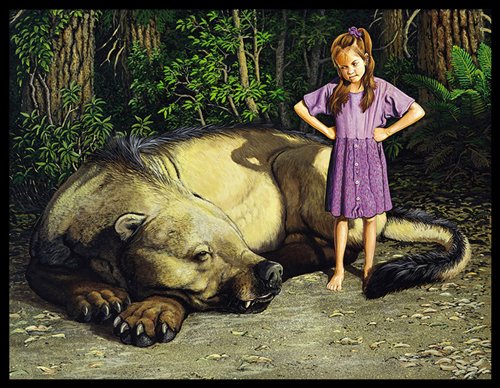
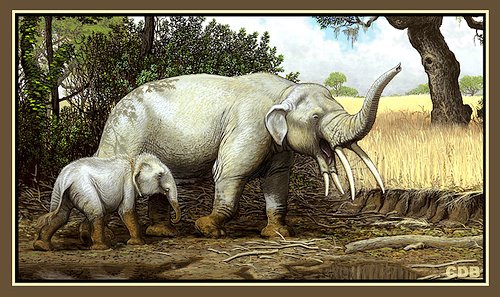
Megistotherium & Karianne


These are just a few of the great images over at the Olduvai George blog. Here at the Palaeoblog we love good art almost as much as palaeontology and this site offers lots of wonderful palaeo (and other) art, and tips on drawing digitally (even though these examples are painted in traditional fashion in acrylic on illustration board). Highly recommended.


Images are © the artist.

Coelacanths Pushed To Extinction By Trawlers

From an article by Inigo Gilmore in The Observer:
It seems that man may have discovered the fish just to eradicate it, as ever deeper trawling throws up serious fears for the already dwindling populations of the fish, which lives at depths of between 100 and 300 metres.
The appearance of these creatures off the Tanzanian coast is a dramatic and as yet unfinished chapter in the extraordinary story of the coelacanth, an ancient fish that was 'rediscovered'. The coelacanth evolved 400 million years ago and was believed to have gone the way of the dinosaurs until one was caught off the coast of South Africa in 1938.


Image from HERE.

The coelacanth has a remarkable physiology - it has no backbone, but an oil-filled 'notochord' and four limb-like appendages, with stubby fins. It has a double tail and gives birth to as many as 26 young at one time. It is believed to gestate for 14 months and may live for more than 80 years. The young develop inside the mother, attached to the outside of a huge yolk-filled egg of about 100mm in diameter.

It was in August 2004 that the local fisheries authority first received a phone call saying fishermen in Kigombe had caught a 'strange' fish. Officials went to check and to their amazement found two specimens of Latimira chalumnae - the coelacanth. Over the next five months 19 more were netted - weighing between 25kg and 80kg. Another appeared last January, then there was a gap until the fish again turned up as The Observer visited.

The numbers are perplexing officials of the Tanga Coastal Zone Conservation and Development Programme, which has a long-term strategy for protecting the species, with the help of Irish aid. They see a connection with trawling - especially by big Japanese vessels - near the coelacanth's habitat, as within a couple of days of trawlers casting their nets coelacanths have turned up in shallow-water nets intended for sharks.

Read the full article HERE.

Happy Birthday To: Hans-Dieter Sues

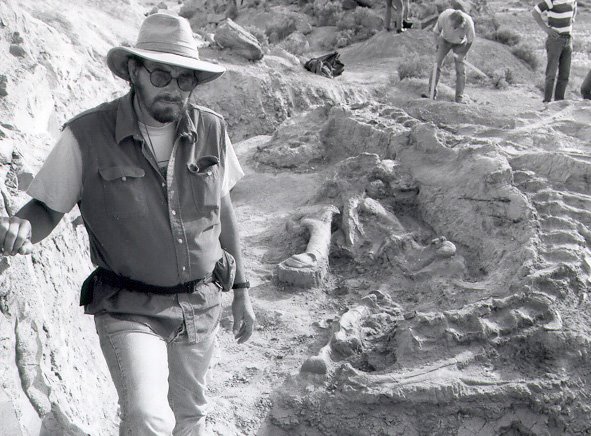
Hans-Dieter is one of the top vertebrate palaeontologists working in the world today. He is currently the Associate Director for Research and Collections for the Smithsonian National Museum of Natural History. You can read a slightly out-of-date bio of Hans HERE.

Thursday, January 12, 2006

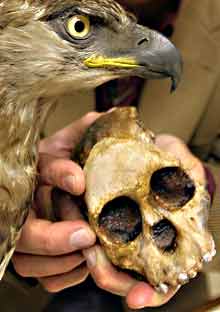
Taung Child Killed By Eagle

From Ed Stoddard at RedOrbit News come this article:
Scientists announced on Thursday they had definitive proof that the "Taung child," a 2-million year old apeman skull, famed as one of the most dramatic human evolutionary finds, was killed and eaten by an eagle.
Unearthed in South Africa in 1924, the Taung child shook the scientific world when Raymond Dart suggested in 1925 that it was a higher form of primate which he dubbed Australopithecus africanus, or "man-ape of southern Africa."

For decades it was believed that the famous Taung child had been slain by a leopard or a saber-toothed cat. But 10 years ago Berger and a colleague suggested that the child, who was about 3 or 4 years old when it died, was killed by a large bird of prey.

"These critical clues were puncture marks in the base of the eye sockets of primates, made when the eagles ripped the eyes out of the dead monkeys with their sharp talons and beaks. It was a marker that others hadn't noted before, that linked eagles definitively to the kill," Berger said.

Berger said the child had probably been scooped up by an eagle and taken to its nest, where its eyes were ripped out for dinner. The child's skull eventually fell out of the nest, only to be found almost 2 million years later.

Placing us on the eagle's menu may also explain other aspects of human evolution, from walking upright, which could present a smaller target to an aerial attacker, to our tendency to live in groups.

The announcement about the Taung child was made on Thursday at an international conference held at Wits. The conference celebrates the 80th anniversary of the Taung child's discovery and the 80th birthday of Professor Phillip Tobias. The papers detailing the discoveries will appear shortly in the American Journal of Physical Anthropology.

Read more about it HERE. Photo from HERE.

To The Batcave!

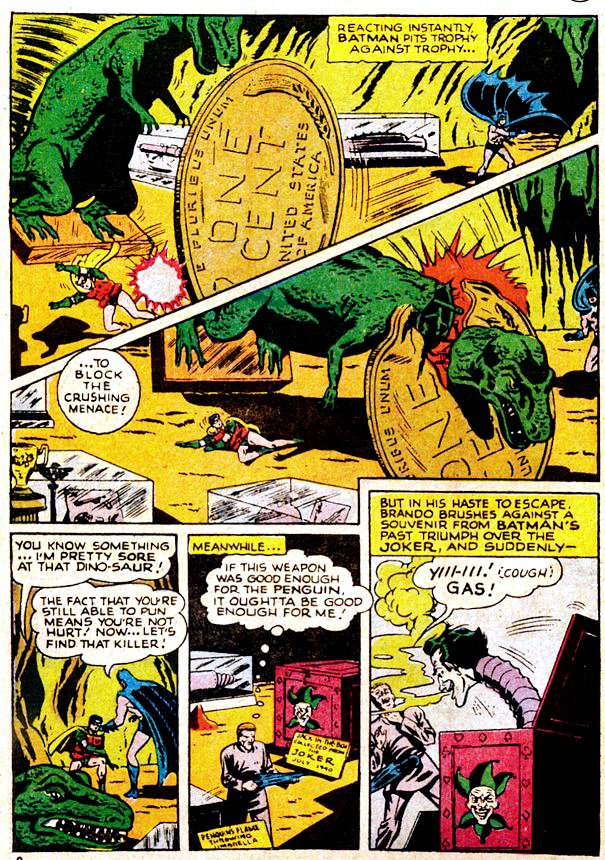
Thanks To Robby Reed over at Dial B For Blog we know that today marks the 40th anniversary of the debut of the Batman TV show on ABC TV in 1966.


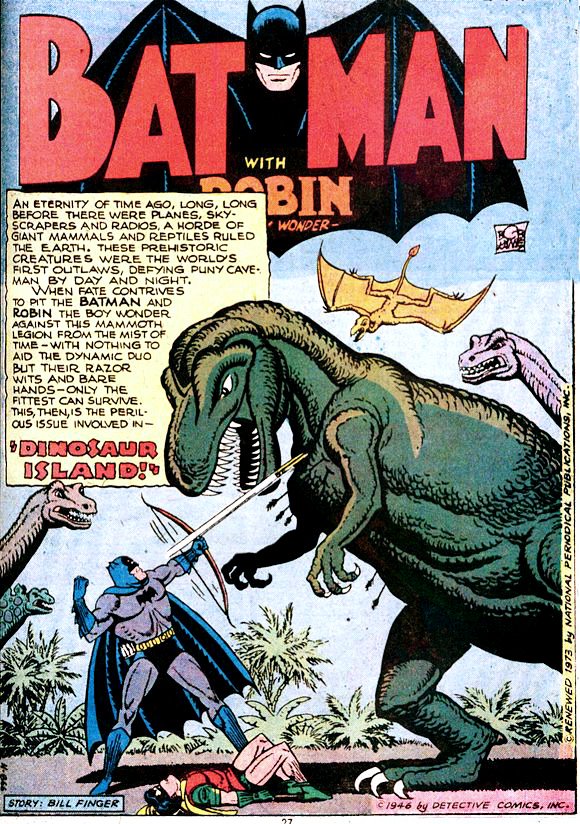
One of the more mysterious items in Bat-lore is the presence of a giant T. rex in the trophy room of the Batcave. THIS SITE inflorms us that the T. rex (above) first appeared in Batman #35 in June 1946 with art by Bob Kane and Ray Burnley.


The dinosaur showed up in the Batcave two years later in Batman #48 in August 1948 with art by Jim Mooney.

Akidolestes: New Mozaic Mesozoic Mammal

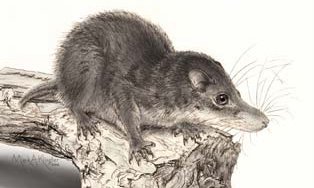
A Cretaceous symmetrodont therian with some monotreme-like postcranial features. 2006. Gang Li and Zhe-Xi Luo. Nature 439: 195-200.


Illustration courtesy Mark A. Klingler/CMNH

From James Owen at National Geographic News comes this article:
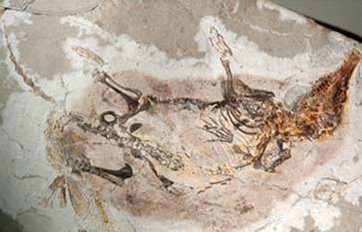
Scientists in China have discovered the fossilized 125 million year old remains a small mammal that walked like a platypus but looked like a shrew. The unusual find provides important new clues to the evolution of early mammals, the researchers say.
Measuring just 4 cm long and weighing 15 to 20 grams, Akidolestes had a thick coat of fur with jaws, teeth, and forelimbs that identify it as a close relative of modern placental and marsupial mammals. But the researchers noted a highly unusual back-half to its skeleton—similar to that of primitive, egg-laying mammals known as monotremes. The only living descendants of monotremes are the strange duck-billed platypus of Australia and two species of spiny anteaters, or echidnas.

Akidolestes had a front posture and gait similar to that of a squirrel, with elbows tucked under its body, but its hind legs had the sprawling appearance of a lizard's. "The walking and running movement in Akidolestes would be similar to the platypus," said Zhe-Xi Luo, curator of vertebrate paleontology at Carnegie Museum of Natural History in Pittsburgh, Pennsylvania.


photo courtesy Zhe-Xi Luo

The fossil challenges conventional wisdom about how placental mammals split from earlier egg-layers. The split may not have been as clear-cut as previously thought, they say. Some placental mammals have have readopted some of the physical characteristics of monotremes.

Read the full article HERE.

Wednesday, January 11, 2006

Frog Extinctions Linked To Climate Change

Widespread amphibian extinctions from epidemic disease driven by global warming. 2006. J. Alan Pounds, et al. Nature 439: 161-167.


Image from HERE.
A new report that links global warming to the recent extinction of dozens of amphibian species in tropical America is more evidence of a large phenomena that may affect broad regions, many animal species and ultimately humans.
The study finds compelling evidence that global climate change created favorable conditions for a pathogenic fungus in Central and South America. That fungus, in turn, led to widespread extinctions of harlequin frogs at middle elevations of mountainous regions.

An OSU scientist who pioneered the study of global amphibian decline said this is another key example of unanticipated and complex impacts from climate change. The Central and South American crisis is "an amphibian alarm call," he said, but also is a harbinger of much greater biological disruption. What had been seen as an enigma is now understood as a complex relationship between global warming and major extinction of species.

"This new study is a breakthrough, and the powerful synergy between pathogen transmission and climate change should give us cause for concern about human health in a warmer world," said Andrew Blaustein, a professor of zoology at OSU, in the Nature article. "As global change is occurring at an unprecedented pace, we should expect many other host taxa, from ants to zebras, to be confronted with similar challenges."

Why I Go To Work Each Day


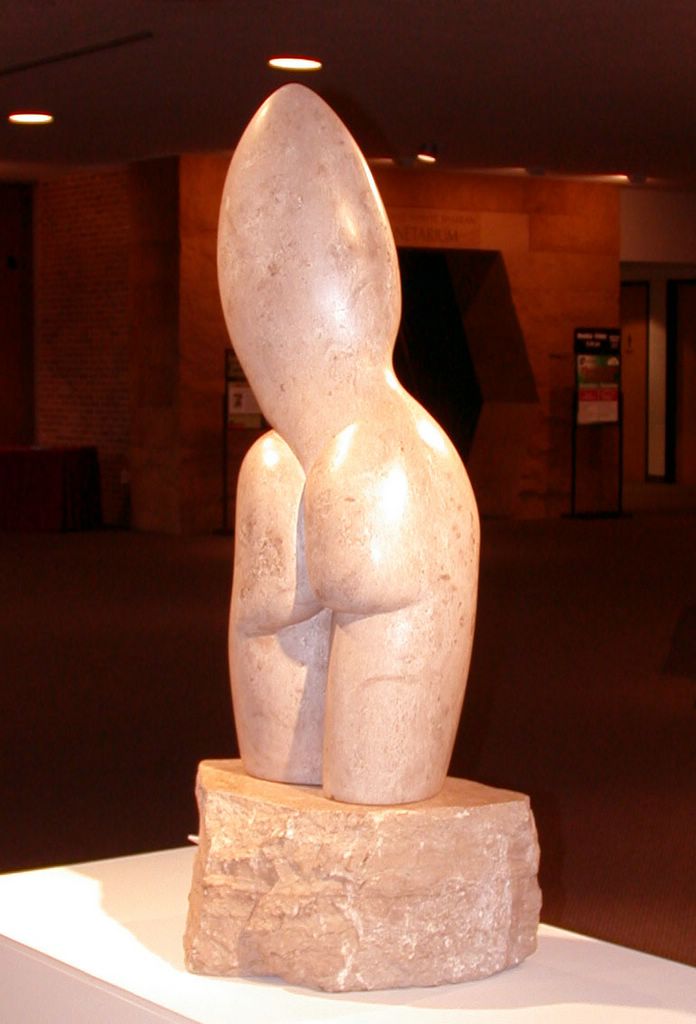
Until March 5, 2006, the Cleveland Museum of Natural History is featuring the work of Charles Herndon. Herndon works out of his studios on Kelleys Island in Lake Erie. His work derives, in large part, from his experience of the natural features and processes he has observed on the island. Herdon does interesting sculptures using the glacial erratics that he collects from the region.

The Dept. of Vert Paleo has produced a cast of the ‘Herdon Bird’ that is available to purchase through the bookstore.


Photos © M. Ryan.

Tuesday, January 10, 2006

Born Today: Nicolaus Steno

Jan. 10, 1683 - Nov. 26, 1686

Steno was born in Copenhagen where he studied medicine. After brief visits to Paris and Rome he worked in Florence as an anatomist.From there he carried out extensive geological studies through Italy, Austria, Germany and the Netherlands. After having returned to Florence he converted from Lutheran to Catholic faith and was ordained as a priest. He dedicated himself in various religious positions to the dissemination of the Catholic faith. With his treatise on solid bodies that by nature are enclosed in other solid bodies, he became the founder of palaeontology as well as of geology and assumed in his theory of earthquakes that they occur due to the raising and subsidence of earth strata.

Info from HERE. Image from HERE. Visit the Steno Museum HERE

Ice Age Climatic Cycling

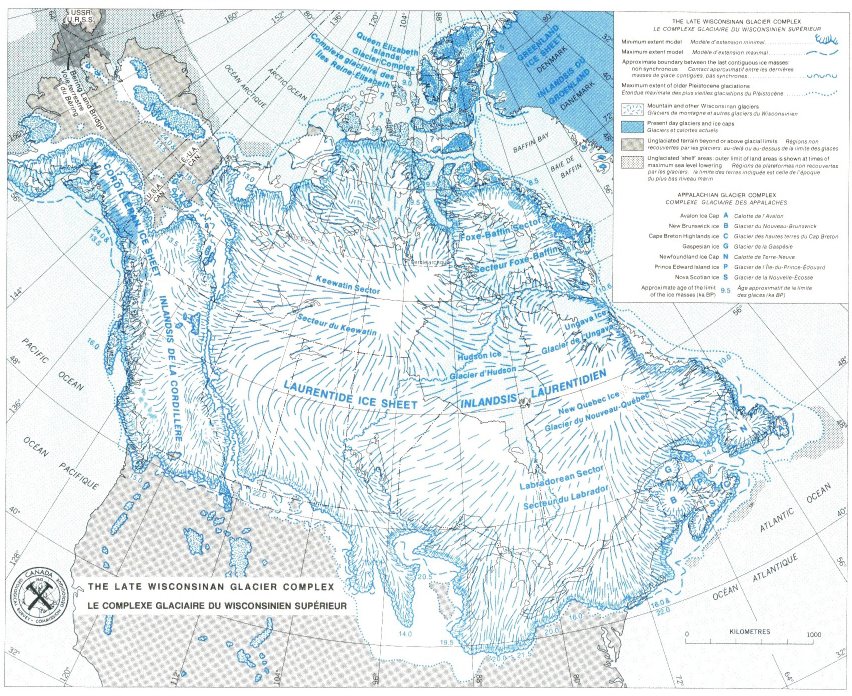
Expansion of alpine glaciers in Pacific North America in the first millennium A.D. 2006. A.V. Reyes, et al. Geology: Vol. 34: 57–60.
The glacier data reported by Reyes and colleagues, together with other clues of past climate, support an emerging idea that climate in the North Pacific region has cycled from warmer to colder intervals several times over the last 10,000 years.

Image from HERE.

ABSTRACT: Radiocarbon ages and lichen-dated moraines from 17 glaciers in coastal and near- coastal British Columbia and Alaska document a widespread glacier advance during the first millennium A.D. Glaciers at several sites began advancing ca. A.D. 200–300 based on radiocarbon-dated overridden forests. The advance is centered on A.D. 400–700, when glaciers along an 2000 km transect of the Pacific North American cordillera overrode forests, impounded lakes, and deposited moraines. The synchroneity of this glacier advance and inferred cooling over a large area suggest a regional climate forcing and, together with other proxy evidence for late Holocene environmental change during the Medieval Warm Period and Little Ice Age, provide support for millennial-scale climate variability in the North Pacific region.

Monday, January 09, 2006

Born Today: Amadeus William Grabau

Jan 9, 1870 – March 20, 1946.

From Today In Science History:

Grabau was an American geologist and paleontologist, known for his work on world stratigraphic deposits and the deciphering of Earth history. In 1899, he published an early paper that studied the environment of old sedimentary rocks in light of knowledge of the conditions of life among modern organisms, The Relations of Marine Bionomy to Stratigraph, which was a step toward the development of paleoecology. For more than a quarter of a century, he worked on the geologic survey of China. In 1940, he developed a theory of rhythms in the growth of the Earth's crust, and of repetitions in mountain building.

Image from HERE.

Jack Postponed


© Museum of the Rockies

Thanks to Dan Varner for pointing out that Jack Horner's talk in Delaware has been postponed. Go the the museum's web page www.delmnh.org for more info.

‘Godzilla’-Croc Paper Published

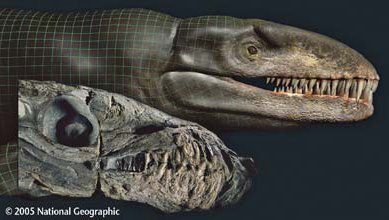
An Unusual Marine Crocodyliform from the Jurassic-Cretaceous Boundary of Patagonia. 2006. Z. Gasparini et al. Science vol. 311: 70-73.


Abstract: Remains of the marine crocodyliform Dakosaurus andiniensis from western South America reveal a lineage that drastically deviated from the skull morphology that characterizes marine crocodyliforms. The snout and lower jaw are extremely robust, short, and high and only bear a few large teeth with serrated edges (resembling those of some terrestrial carnivorous archosaurs). This unusual morphology contrasts with the long and gracile snout and lower jaws bearing numerous teeth, which are present in the closest relatives of D. andiniensis (and interpreted as indicating feeding on small fish or mollusks). Thus, the morphological diversity of pelagic marine crocodyliforms was wider than had been thought.

Sunday, January 08, 2006

Classic Alley Oop


Alley Oop from The Holloway Pages.

Born This Day: Alfred Russel Wallace

Jan. 8, 1823 – Nov. 7, 1913

From Today In Science History:

Wallace was a British naturalist and biogeographer. He was the first westerner to describe some of the most interesting natural habitats in the tropics. He is best known for devising a theory of the origin of species through natural selection made independently of Darwin.

Between 1854 and 1862, Wallace assembled evidence of natural selection in the Malay Archipelago, sending his conclusions to Darwin in England. Their findings were jointly presented to the Linnaean Society in 1858. Wallace found that Australian species were more primitive, in evolutionary terms, than those of Asia, and that this reflected the stage at which the two continents had become separated. He proposed an imaginary line (now known as Wallace's line) dividing the fauna of the two regions.

The Alfred Russel Wallace page HERE. More HERE.

Saturday, January 07, 2006

Cats Climb New Family Tree


Top Cat from HERE.

The Late Miocene Radiation of Modern Felidae: A Genetic Assessment. W. E. Johnson et al. Science vol. 311: 73-77.

Abstract: Modern felid species descend from relatively recent (<11 million years ago) divergence and speciation events that produced successful predatory carnivores worldwide but that have confounded taxonomic classifications. A highly resolved molecular phylogeny with divergence dates for all living cat species, derived from autosomal, X-linked, Y-linked, and mitochondrial gene segments (22,789 base pairs) and 16 fossil calibrations define eight principal lineages produced through at least 10 intercontinental migrations facilitated by sea-level fluctuations. A ghost lineage analysis indicates that available felid fossils underestimate (i.e., unrepresented basal branch length) first occurrence by an average of 76%, revealing a low representation of felid lineages in paleontological remains. The phylogenetic performance of distinct gene classes showed that Y-chromosome segments are appreciably more informative than mitochondrial DNA, X-linked, or autosomal genes in resolving the rapid Felidae species radiation.

From Shaoni Bhattacharya at New Scientist.com comes this article:
Despite their occasional fierceness, the domestic cat diverged from its “roaring” cousins, such as lions, jaguar and tigers, 10.8 million years ago – just after the evolution of the ancestor of all modern cats. The revelation comes from a thorough new genetic analysis of the cat family tree.
Cats are “one of the world’s most successful carnivore families, inhabiting all continents except Antarctica”, say the researchers, but modern species evolved only relatively recently – about 11 million years ago.

Originating in Asia, they successfully traversed and colonized the globe, with the periodic rise and fall of the sea level facilitating their spread and evolution into new species, the new study suggests. The cat family tree has been notoriously difficult to decipher because there are few dated cat fossils and because most of today’s species appeared so recently.

Johnson’s team managed to piece together a tree by analysing DNA sequences from the 37 living cat species. They used DNA from the sex chromosomes, X and Y, and from mitochondria – structures in the cell which provide energy and are inherited only via the mother.

They suggest that after modern cats arose in Asia, the eight main lineages diverged during the course of at least 10 migrations across continents. The felines used geographical features such as the Bering land bridge, which once connected Eurasia to North America, and the Panamanian land bridge, connecting North and South America, to spread across the world. The team also suggests that 60% of the modern species arose in just the last million years.

Friday, January 06, 2006

Kong’s Triceratops


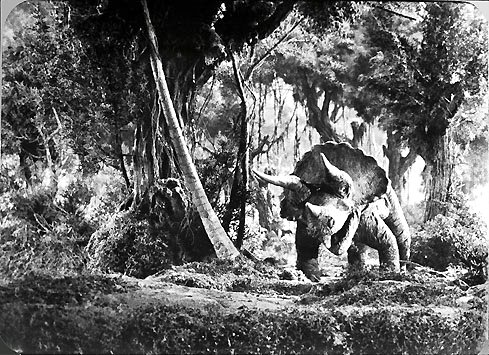
Dan Varner sent along the above picture. It’s a Triceratops built by Marcel Delgado for Willis O’Brien’s aborted film project, “Creation”. A ceratopsian was, apparently, in the script for the original King Kong but was never filmed. Peter Jackson and his crew of skilled technicians created a new one that can be seen in the new spider pit sequence that Jackson did for the bonus features of the recently released 1933 King Kong DVD package.

Check out Dan’s art at www.oceansofkansas.com.

Born This Day: George Ledyard Stebbins

Jan. 6, 1906 - Jan. 19 2000.

From the University and Jepson Herbaria, U of California, Berkeley:

Along with Dobzhansky (1900 - 1975), animal systematist Ernst Mayr, and paleontologist George Gaylord Simpson (1902 - 1984), Stebbins is considered one of the "architects" of the modern evolutionary synthesis of the 1930s and 1940s, an intellectual watershed and historic turning point that brought together research in cytology, genetics, systematics, paleontology into a common evolutionary framework. This synthesis, which had the effect of reconciling the often opposing views of laboratory-oriented geneticists and natural history oriented systematists, made Charles Darwin's theory of evolution by natural selection the centerpiece of the new discipline of evolutionary biology.

In this role, Stebbins is credited with bringing a modern framework to the study of plant evolution, and he is perhaps best known for his book Variation and Evolution in Plants, published by Columbia University Press (NY) in 1950. In the 1940s, Stebbins also played an important role in organizing the nascent Society for the Study of Evolution, of which he became the third president in 1948, and used his position to speak out for the botanical side of evolutionary studies, a field that had been dominated by zoologists.

Photo from HERE.