Thursday, June 30, 2005

The Big Questions In Science

In a special collection of articles published beginning 1 July 2005, Science Magazine and its online companion sites celebrate the journal's 125th anniversary with a look forward -- at the most compelling puzzles and questions facing scientists today. A special, free news feature in Science explores 125 big questions that face scientific inquiry over the next quarter-century; accompanying the feature are several online extras including a reader's forum on the big questions.

Some of the top 25 questions of interest to readers of this blog include:

How and Where Did Life on Earth Arise? by Carl Zimmer

What Determines Species Diversity? by Elizabeth Pennisi

To read all the articles click HERE.

He Saw Horses, Horses, Horses, ...


Evolution, systematics, and phylogeography of pleistocene horses in the New World: A molecular perspective. 2005. Weinstock, J., E. Willerslev, A. Sher, Tong W.-f., S. Y. W. Ho, D. Rubenstein, J. Storer, J. Burns, L. Martin, C. Bravi, A. Prieto, D. Froese, E. Scott, Lai X.-l., and A. Cooper. Public Library of Science Biology: 3(8) [August, 2005] (doi: 10.1371/journal.pbio.0030241)

From EurekAlerts come this article:

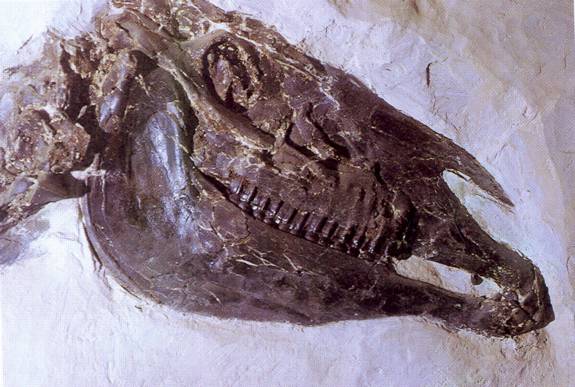
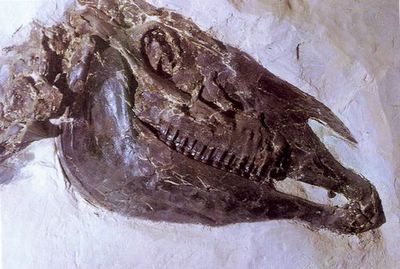
The Patagonian Hippidion horse genus and North American stilt-legged horses have found a new place on the evolutionary tree, according to a new article in the open access journal PLoS Biology. In the paper, Jaco Weinstock, Alan Cooper, and colleagues use ancient DNA to argue that the Hippidion genus is younger than previously thought and that American stilt-legged horses were American endemics, not Asian emigres. Their analysis has also whittled down the taxonomy of North American species to just two.

"I think the biggest issue is that we showed the apparent lack of species diversity in North American horses in the Late Pleistocene - as horses are a poster child of evolution," says Cooper.

To explore the origins of the horses, the authors examined mitochondrial DNA (mtDNA) extracted from fossilized horse bones. Mitochondria, which have their own genome, contain a stretch of sequence that's useful for inferring evolutionary relationships: though the region undergoes high mutation rates, the patterns of mutations remain stable over thousands of generations. The mtDNA analysis of the South and North American horses provided evidence that stilt-legged horses, the Hippidion genus, and caballine, or true horses, all arose from a common lineage.

Read the complete article HERE.

Q: Are We Not Men...?

In this week’s issue of Nature Henry Gee writes a fanciful piece for their ‘Futures’ section addressing the outcome of the recent proliferation of new hominid species.


"When the time came, they just settled down with us, side by side. Just ten years after the first Sasquatches came out of northern British Columbia in '39 in search of whiskey, the hominids were everywhere, and nobody raised a brow-ridge. It would be commonplace to find (say) a Sumatran Pendek driving your cab to work; your lunch cooked and served by a Malaysian Jive Monkey (and before you complain, that's what they called themselves); and an eight-foot Kaptar from the Pamirs, pole-dancing to Earth, Wind and Fire in a club after work (but only if you were into that kind of thing)."
Read the full text HERE.

Wednesday, June 29, 2005

King Kong Trailer

From www.stuff.co.nz - Peter Jackson's King KongI think the title says it all!

The trailer was released earlier this week and has added to the positive buzz for the movie.

You can see the trailer at kingkongmovie.com; you'll need QuickTime to view it.

For the more fanatical amongst us, there is already a screen-by-screen analysis on kongisking.net.

As it is a holiday weekend coming up, posting will be sporadic for a few days - hope everyone (both in Canada and the U.S.) has a very happy holiday weekend!

Born this day: Ray Harryhausen

Unlike Michael (our absent Palaeoblogger), I don't have in depth knowledge of the comic book/dinosaur graphic art and movie domain. However, I would be remiss if I didn't mention that on this day in history, Ray Harryhausen was born in 1920 (fortunately, he is still with us today).

Known primarily for his stop-motion animation work in the movies "Jason and the Argonauts" and "The Seventh Voyage of Sinbad", he is widely considered to be one of the giants in movie animation. Many directors making movies today - including Peter Jackson - count Harryhausen as a major influence in their movie making, making his work highly relevant today.

Happy 85th Birthday, Ray!

Here are some links to sites about Ray Harryhausen and his work:
  • Jason and the Argonauts Information Page
  • "The Fantastic Films of Ray Harryhausen" - a tribute site with many pictures and trailers
  • A February, 2000 interview from Animation World Magazine

Tuesday, June 28, 2005

Paleo-Path Part 11 This Friday


Even though I'm in the field right now I've still made time to put together a new Paleo-Path column for this week featuring our own dino-drawin', 'Prehysterical' Pete Von Sholly.

Tune in this Friday for the scoop!

Monday, June 27, 2005

Dinosaurs Parade The Circle

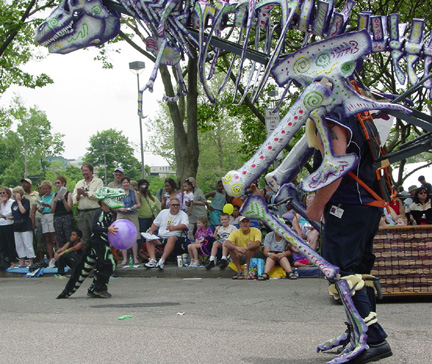
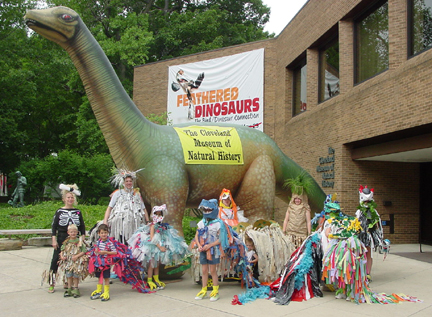
On the weekend of June 10-11, the Cleveland Museum of Natural History took part in the big 'Parade The Circle' along with the other members of the University Circle including The Cleveland Art gallery and the Cleveland Botanical Gardens. A number of young museum volunteers built some elaborate and beautiful dinosaur masks and costumes under the direction of Susan Rozman, who also took these photos. A great day was had by all!


Sunday, June 26, 2005

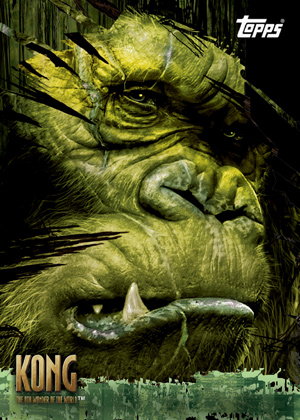
Kong Is Topps


From PSACards.com:

The Topps Company has been awarded the license to publish official KING KONG trading cards based on the upcoming movie from Universal Pictures and Academy Award-winning director Peter Jackson.

Topps plans an ambitious card program for KING KONG, worthy of the grand scale of the movie. “The chance to be a part of a milestone cultural event this big rarely comes around,” says Topps’ Friedman. “We’re creating fun, collectible cards to appeal to KONG fans and collectors of every age.” The Topps movie tie-in cards will appear on retail counters in advance of KING KONG’s theatrical debut.

Founded in 1938, Topps is a leading creator and marketer of distinctive confectionery and entertainment products. The Company’s confectionery brands include “Ring Pop,” “Push Pop,” “Baby Bottle Pop” and “Juicy Drop Pop” lollipops as well as “Bazooka” bubble gum. Topps entertainment products include trading cards, sticker and album collections, and collectible games.

For additional information, visit For additional information, visit www.topps.com.

Friday, June 24, 2005

The Call Of The West

I'm off to the field but the Palaeoblog continues on, so stay tuned in for frequent updates!


"I feel a hot wind on my shoulder
And the touch of a world that is older
"
Listen to the Call of the West HERE.

Thursday, June 23, 2005

New Discovery: Two Palaeocene Mammals Had Venomous Bite

from NationalGeographic.com - image of fossilized teethRichard Fox of the University of Alberta has uncovered fossilized "dagger-like" teeth for two mammals in Central Alberta. The previously known Bisonalveus browni - a shrewlike animal - and a second, unnamed animal exhibit the characteristics needed for venom delivery.

The teeth - which have no corresponding groove on the lower jaw - would have been used to stab prey (most likely beetles). The presence of these teeth suggest that this predation strategy may have been more common than previously thought during the Palaeocene.

There are only four mammals on the planet today that use venom - the Caribbean Solenodon the North American Short-tailed Shrew, the Eurasian Water Shrew, and Australia's Duck-billed Platypus.


Read the LETTER at Nature.com

Smithsonian Dinosaurs On-Line


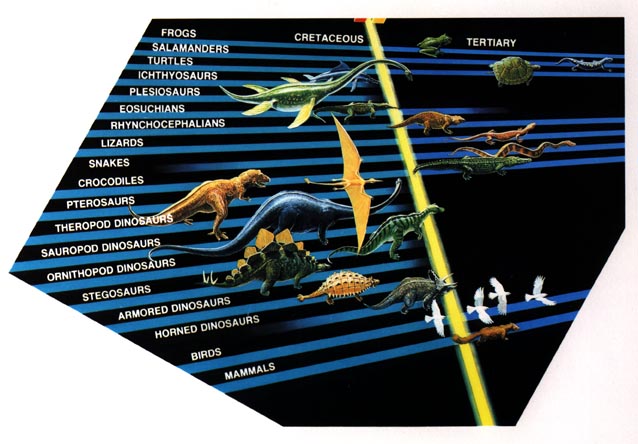
The Smithsonian has several new on-line features of interest to readers of the Palaeoblog including an informative listing of its extensive collection of type fossils.
The Smithsonian Institution is one of the largest museum systems in the world, and has served as a repository for animal, plant, and other natural history specimens since its founding in 1846. Today the National Museum of Natural History houses these collections—totaling over 124 million specimens—in its 1910 building at 10th and Constitution Avenue, Washington, D.C., and in its Museum Support Center in Suitland, MD.

Among these, many are type specimens, the original and name-bearing specimens for new species. These important materials form a foundation for comparative biology and systematics, because they represent the focal point for the identification and naming of new taxa.

The 40 million specimens in the Paleobiology Department include 250,000 of these types, 46 of which are dinosaurs. These specimens represent only a small fraction of the more than 1000 known dinosaur species, but many are unusually complete and important specimens. In particular, the types of Ceratosaurus nasicornis, Stegosaurus stenops, Camptosaurus browni, and Thescelosaurus neglectus are among the finest specimens known for these dinosaur species.

Click to visit: GEOLOGIC TIME: THE STORY OF A CHANGING EARTH, DINOSAURS!. or LIFE OF A VERTEBRATE FOSSIL.

Wednesday, June 22, 2005

Bone Sharps


It's coming to bookshops later this summer. Read all about it HERE.

Pay attention to the paragraph about the ILLUSTRATED CHARLES KNIGHT AUTOBIOGRAPHY that the same company will soon be publishing. But it's not illustrated by Knight; instead it features a dozen beautiful B&W illustrations by Mark Schultz of selected incidents in Knight's life. I've seen Mark's original drawings for this and they are without a doubt the BEST WORK of his career -- no lie!

'Boiled' Eggs & Dinosaur Sex Ratios


Image from HERE.

In the discussion of what killed off the dinosaurs at the end of the Cretaceous you’ll often read that the asteroid impact coincidental with the Cretaceous-Tertiary boundary caused extreme environmental changes. Scientists know that the sex ratio of some incubating reptile eggs can be strongly effected by temperature with more males hatching at low temperatures and more females hatching at higher temperatures. If the average temperature at the end of the Cretaceous changed enough to effect the sex ratio of enough different types of dinosaurs over a long enough period of time, the resulting imbalance in the number of males to females born could have contributed to their extinction.

In the paper below, Ann Göth and David T. Booth show for the first time that the incubating eggs of some living birds show a similar response to temperature. Since extinct dinosaurs are phylogenetically bracketed by reptiles and living birds it stands to reason that dinosaurs could have been susceptible to the same problem.

Temperature-dependent sex ratio in a bird. Ann Göth and David T. Booth. Biology Letters 1: 31-33. DOI: 10.1098/rsbl.2004.0244

Abstract: To our knowledge, there is, so far, no evidence that incubation temperature can affect sex ratios in birds, although this is common in reptiles. Here, we show that incubation temperature does affect sex ratios in megapodes, which are exceptional among birds because they use environmental heat sources for incubation. In the Australian brush-turkey Alectura lathami, a mound-building megapode, more males hatch at low incubation temperatures and more females hatch at high temperatures, whereas the proportion is 1:1 at the average temperature found in natural mounds. Chicks from lower temperatures weigh less, which probably affects offspring survival, but are not smaller. Megapodes possess heteromorphic sex chromosomes like other birds, which eliminates temperature-dependent sex determination, as described for reptiles, as the mechanism behind the skewed sex ratios at high and low temperatures. Instead, our data suggest a sex-biased temperature-sensitive embryo mortality because mortality was greater at the lower and higher temperatures, and minimal at the middle temperature where the sex ratio was 1:1.

Tuesday, June 21, 2005

Plans For Dino-Theme Restaurants

Image of Jurassic Park T-Rex from Big Skins WallpaperThe creator of the Rainforest Café has come up with a new idea for a chain: "T-Rex", a dinosaur theme-restaurant that will be an edutainment experience that also provides dining and shopping opportunities.

The first restaurant is scheduled to open in Kansas City, Missouri next year; plans for a total of 8 restaurants in markets already possessing major tourist attractions are in the works.

Based on the menu at the Rainforest Cafe, we can almost be assured of a 'Brontosaurus' Burger...

Read the official press release.

Monday, June 20, 2005

On Newsstands Now - Dinosaurs!

June 20, 2005 Newsweek cover from MSNBC.comThe cover story of the current issue of Newsweek (June 20) discusses some of the more notable discoveries in vertebrate paleontology over the past several years. The article it appears to be a partial overview of the American Museum of Natural History's "Dinosaurs: Ancient Fossils, New Discoveries" exhibit.

Among the topics covered in the article are:

Rise Of The Robosaurs


From an article by Robert Jones in the New Zealand Herald:

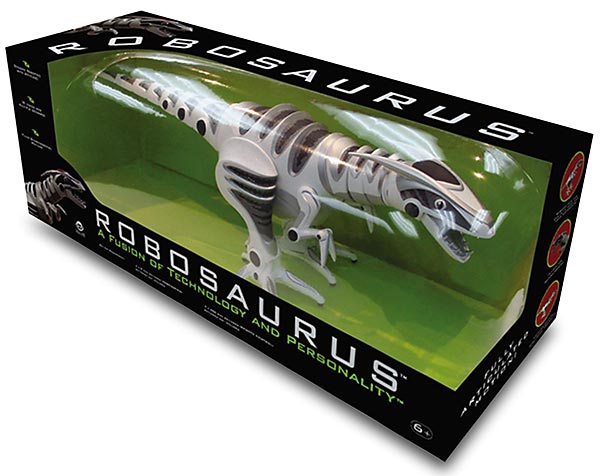
Roboraptor, is a new 32-inch long hi-tech robo-beast with three mood levels - hunter, cautious and playful - and 40 pre-programmed functions - or buyers can just let him run wild. The $200 toy is part of the Robosapien range designed by ex-Nasa scientist Mark Tilden.

Tilden, who worked for Nasa building "real" robots before realising that nobody wanted those kinds of things in their home, hopes that by building friendly toy robots using proper robotic techniques, people will become comfortable with them and welcome them into their families. After seeing the Roboraptor it’s clear that Tilden is bent on world domination and is not to be trusted.

You can leave Roboraptor to guard a particular area, or in remote control mode so he’s at your beck and call, or just let him do his own thing in free-roam mode. If you ignore him long enough he’ll get bored and switch himself over to free roaming anyway and go off looking for some baby birds to torment or a Robosapien to torture.


You can even lead the Roboraptor around by tracing a path using the remote control’s laser beam. Or you can ignore the remote altogether and just poke him and watch him dance - oh, how he can dance. He can also waddle, hunt and run so make sure you’re a safe distance away before taunting him.

Read the rest of the story HERE. Images from HERE.

Sunday, June 19, 2005

Hall of Teeth and Horns is Open

The new Hall of Teeth and Horns at the Museum of the Rockies - previously mentioned in PALAEOBLOG - is now open to the public.

The Hall is the part of the larger Siebel Dinosaur Complex to be completed in 2007. The complex will be over 10,000 sqaure feet in size and house over 4,000 Montana specimens. Among the items currently on display are the bone containing dinosaur soft tissue and a reconstruction of the Torosaurus which had its skull airlifted on NBC's Today show back in 2001.

Read the original PALAEOBLOG posts:
Read the full article.

South American Dinosaur Track Site Shows Late Cretaceous Biodiversity

From language.com, photos of the Cal Orcko dinosaur tracksThe paleontological team at the Cal Orko cement quarry in Sucre, Bolivia (near the center of the country) discovered over 5,000 tracks belonging to 294 dinosaur species. During the late Cretaceous, this area was a shallow lake; subsequent upheaval exposed the tracks in a near-vertical position.

Tracks for sauropods and theropods have been found, but also discovered were tracks for an ankylosaurus, an animal previously not found in South America. A Cretaceous Park is planned to open on the site next spring, to help preserve and protect the vulnerable outcroppings.

Read the full article at Tierramérica.

Saturday, June 18, 2005

A Mammoth Conclusion

From Pennsyvania’s Times Leader.com:

Japanese scientists said Friday that DNA tests have shown that the prehistoric woolly mammoth is more closely related to Asian elephants than to their African counterparts, settling a long-running debate over the lineage of the giant animals that went extinct 10,000 years ago.


Nagoya University professor Tomoo Ozawa and his team examined muscle tissue DNA taken from a woolly mammoth excavated in Siberia and determined that the mammoth and Asiatic elephants branched off from the same ancestor 4.8 million years ago. African elephants diverged from the family tree earlier on, about 7.3 million years ago, the group said. Ozawa's group analyzed DNA taken from the mammoth and compared it with that of Asiatic and African elephants. Experts' views had been divided over which group of elephants the woolly mammoth was more closely related to.

Read the rest of the story HERE. Image from HERE.

Darwin Dogs Beagle For BBC 4

Few voyages have had more impact on science than Charles Darwin's visit to the Galapagos Islands in 1835. The archipelago of volcanic islands off Ecuador, with their unique diversity of plant and animal life, inspired Darwin's first ideas of evolution.
From BBC.CO.UK:

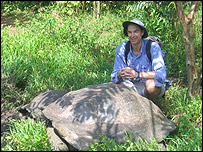
Charles Darwin's descendant Chris retraces part of the voyage for BBC Radio 4's “It's My Story”. He says the islands retain the sense of mystery and wonder that captivated his great, great grandfather.

"It's still got the innocence that really grabbed him 170 years ago," he told the BBC News website.

But he says the landscape would have looked very different then. The vast tracts of rainforest on the west coast of South America that Charles Darwin would have seen from HMS Beagle have been cleared, while wildlife on the islands has fallen prey to invasive species introduced by humans.

"There has definitely been damage in the sea," says Chris Darwin. "This is something I really noticed between the two trips I have taken. This time, I didn't see a single hammerhead shark and far fewer sea cucumbers."

"It's My Story: Beyond the Beagle" is broadcast on BBC Radio 4 at 2000 BST on Thursday, and then available on the network's website for a short period afterwards.

Read the full story HERE.