"Barney Ban" Will Protect Children, Says State Attorney General Kline. Legislative Leaders' Goal: "Healing Wounds of Darwinism"
Read the full artilce HERE
Friday, May 13, 2005
Thursday, May 12, 2005
Unintelligible Redesign
From The New York Times: [note: registration required]
For another take on this story read this 2002 article by William Saletan from Slate.com: Unintelligible Redesign
This is the way creationism ends. Not with a bang, but with a whimper.
In the first of three daylong hearings being referred to here as a direct descendant of the 1925 Scopes Monkey Trial in Tennessee, a parade of Ph.D.'s testified Thursday about the flaws they saw in mainstream science's explanation of the origins of life. It was one part biology lesson, one part political theater, and the biggest stage yet for the emerging movement known as intelligent design, which posits that life's complexity cannot be explained without a supernatural creator.Register with the NY Times to read the full story.
Darwin's defenders are refusing to testify at the hearings, which were called by the State Board of Education's conservative majority. But their lawyer forcefully cross-examined the other side's experts, pushing them to acknowledge that nothing in the current standards prevented discussion of challenges to evolution, and peppering them with queries both profound and personal.
For another take on this story read this 2002 article by William Saletan from Slate.com: Unintelligible Redesign
This is the way creationism ends. Not with a bang, but with a whimper.


Father Of Noosphere Born This Day
From Today In Science History:
Vladimir Ivanovich Vernadsky
May 12, 1863 - Jan. 6, 1945.
 Russian geochemist and mineralogist who was a founder of the specialist sciences of geochemistry and biogeochemistry. He was the first to popularize the concept of the noosphere - the biosphere controlled by the mind of man. Within the last 200 years, humanity has been a powerful geologic force, moving more mass upon the earth than the biosphere. Two of the laws detailed by Vernadsky are that the number and kinds of chemical elements and compounds entering the cycling organization of living matter increase with time, and that as we move toward the present the pace of cycling increases.
Photo from HERE
Vladimir Ivanovich Vernadsky
May 12, 1863 - Jan. 6, 1945.
 Russian geochemist and mineralogist who was a founder of the specialist sciences of geochemistry and biogeochemistry. He was the first to popularize the concept of the noosphere - the biosphere controlled by the mind of man. Within the last 200 years, humanity has been a powerful geologic force, moving more mass upon the earth than the biosphere. Two of the laws detailed by Vernadsky are that the number and kinds of chemical elements and compounds entering the cycling organization of living matter increase with time, and that as we move toward the present the pace of cycling increases.
 Photo from HERE
British Diplodocus Celebrates 100 Years
 "Dippy" the Diplodocus at London's Natural History Museum celebrates its 100th anniversary today. The 26m long copy of a skeleton of the plant-eating sauropod has been living in the museum since it was donated by King Edward VII on 12 May 1905. The huge beast, one of the longest land animal that ever lived, is now being scrubbed up in honour of its 100th birthday.
 Read more about it HERE.
Wednesday, May 11, 2005
Museum of The Rockies Expands
From the Independent Record:
The Museum of The Rockies in Bozeman, Montana, unveiled its latest phase of its new Siebel Dinosaur Complex; the 5,400-square-foot Hall of Horns and Teeth which will open to the public in June.
Museum of the Rockies marketing director Jamie Cornish said the new exhibit will showcase Jack Horner's dino dream, a vision that shares new breakthroughs in the field that has put Montana on the map. Horner is the museum's curator of paleontology and one of the world's foremost dinosaur experts.
Cornish said the 10,600-square-foot total expansion is based on Horner's book, "Dinosaurs Under the Big Sky." The exhibits will present the latest theories and research in the field.
Displays will include the skull from the now-famous Tyrannosaurus known as B. Rex. Earlier this year, Helena native Mary Schweitzer announced from her North Carolina State University lab that her research team had found what is believed to be soft tissue preserved in the fossilized bones of the 68-million-year-old beast.
The centerpiece of the Hall of Horns and Teeth includes a massive skull belonging to a Torosaurus. The skull was lifted from a cliff near Winnett in July 2001 while cameras from the "Today Show" rolled for a national viewing audience.
Read the rest of the story HERE.
The Museum of The Rockies in Bozeman, Montana, unveiled its latest phase of its new Siebel Dinosaur Complex; the 5,400-square-foot Hall of Horns and Teeth which will open to the public in June.
Museum of the Rockies marketing director Jamie Cornish said the new exhibit will showcase Jack Horner's dino dream, a vision that shares new breakthroughs in the field that has put Montana on the map. Horner is the museum's curator of paleontology and one of the world's foremost dinosaur experts.
Cornish said the 10,600-square-foot total expansion is based on Horner's book, "Dinosaurs Under the Big Sky." The exhibits will present the latest theories and research in the field.
Displays will include the skull from the now-famous Tyrannosaurus known as B. Rex. Earlier this year, Helena native Mary Schweitzer announced from her North Carolina State University lab that her research team had found what is believed to be soft tissue preserved in the fossilized bones of the 68-million-year-old beast.
The centerpiece of the Hall of Horns and Teeth includes a massive skull belonging to a Torosaurus. The skull was lifted from a cliff near Winnett in July 2001 while cameras from the "Today Show" rolled for a national viewing audience.
Read the rest of the story HERE.
Fossil Wars

Photograph (C) National Geographic 2005
The latest issue (May 2005) of National Geographic looks that the commerical fossil trade in an article by Lewis M. Simons with photgraphs by Lynn Johnson.
Read the first part of the article HERE.
Tuesday, May 10, 2005
Mammoth Art
Because I've been thinking about mastodons over the past few days, and because I can do what I want here, I'm posting a nice sketch by a very good artist, Jeff Parker.

Extra points to those readers who can tell me the connection between Jeff's drawing below and palaeontology; hint -- it's not what you think. I'm posting this drawing for The Captain.

Visit Jeff’s site HERE and his blog: Mystifying Oracle.

Extra points to those readers who can tell me the connection between Jeff's drawing below and palaeontology; hint -- it's not what you think. I'm posting this drawing for The Captain.

Visit Jeff’s site HERE and his blog: Mystifying Oracle.
Living 'Fossil' Tree Unveiled
From Telegraph.co.uk:
 A Jurassic tree dating from the dinosaur age and thought to have been extinct for two million years has been unveiled by Sir David Attenborough (left). The tree was found by chance by a National Parks officer as he backpacked in Australia and the discovery astonished botanists worldwide who thought it had died out millions of years ago.
Sir David, who planted the tree, said: "How marvellous and exciting that we should have discovered this rare survivor from such an ancient past. It is romantic, I think, that something has survived 200 million years unchanged."
The Wollemi Pine, discovered 11 years ago, has now taken its place in the Kew Arboretum among the rarest trees in the world. Parks officer David Noble stumbled across it on one of his abseils, as he travelled through the Blue Mountains in Australia. He noticed some unusual foliage and took a sample back to Sydney. Scientists there confirmed it was a new genus of an ancient plant species, called Araucariaceae, which had existed at the time of dinosaurs.
Read the rest of the story HERE.
Image from HERE.
 A Jurassic tree dating from the dinosaur age and thought to have been extinct for two million years has been unveiled by Sir David Attenborough (left). The tree was found by chance by a National Parks officer as he backpacked in Australia and the discovery astonished botanists worldwide who thought it had died out millions of years ago.
Sir David, who planted the tree, said: "How marvellous and exciting that we should have discovered this rare survivor from such an ancient past. It is romantic, I think, that something has survived 200 million years unchanged."
The Wollemi Pine, discovered 11 years ago, has now taken its place in the Kew Arboretum among the rarest trees in the world. Parks officer David Noble stumbled across it on one of his abseils, as he travelled through the Blue Mountains in Australia. He noticed some unusual foliage and took a sample back to Sydney. Scientists there confirmed it was a new genus of an ancient plant species, called Araucariaceae, which had existed at the time of dinosaurs.
Read the rest of the story HERE.
Image from HERE.
Fossil Legends
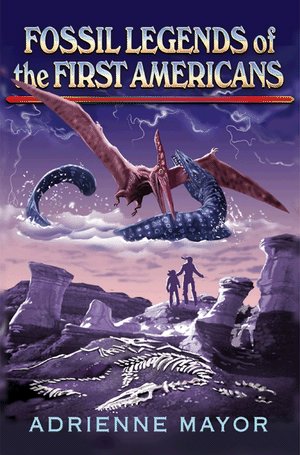
Mayor is a folklorist who made her mark in 2001 with her book, The First Fossil Hunters: Paleontology in Greek and Roman Times, in which she tried to link various dinosaur and prehistoric mammal fossils to specific mythological creatures and legends. In this new book, Fossil Legends of the First Americans she attempts to do the same thing with fossils and Native American myths. Whether you buy into her arguments or not, the book is worth picking up if only for the great Pete Von Sholly cover.
You can see more of Pete’s work and purchase a variety of his publications at Vonshollywood.com.
Monday, May 09, 2005
Inner Mongolia Fossil Show
From The People’s Daily Online:

The photo taken on April 13, 2005 shows a bird fossil belonging to the early Cretaceous period which is unearthed in Ningcheng County, Chifeng City of north China's Inner Mongolia Autonomous Region.

The photo taken on April 13, 2005 shows a bird fossil belonging to the early Cretaceous period which is unearthed in Ningcheng County, Chifeng City of north China's Inner Mongolia Autonomous Region.
More Impact Debate
From Red Nova News:

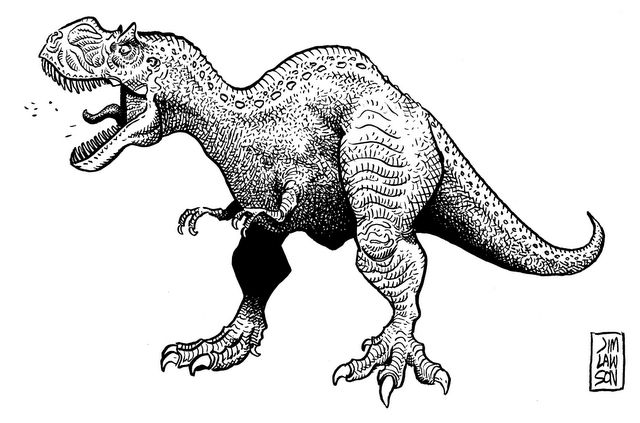
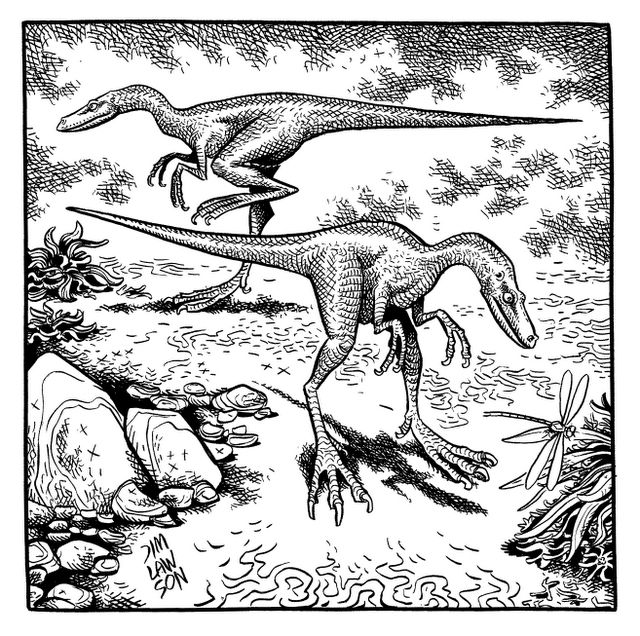
Illos (C) Jim Lawson. Read the article about him this Friday.
Astrobiology Magazine -- At least 50 percent of the world's species, including the dinosaurs, perished 65 million years ago. A large meteorite struck Mexico's Yucatan Peninsula around the same time, and most scientists blame this impact for the mass extinction.Yet there is nothing that directly links meteorite impacts with the extinction of entire species. Scientists can recite a long list of the devastating environmental consequences of a large meteorite impact, but they cannot prove these effects have led to the simultaneous loss of life around the globe. Answering the question of how and why such a large variety of species died out at the same time is one of the greatest mysteries in paleontology.
While the exact reason for the Cretaceous-Tertiary (K-T) mass extinction is still under debate, other past extinctions have been clearly linked with climate change. As species become increasingly specialized to their environment, a substantial or sudden change will tend to threaten their survival. The Earth has gone through many cycles of extreme warming and cooling in its history, with an associated rise and fall of species.
Could such climate change have played a role in the K-T extinction? One proponent of this theory is Dewey McLean, a geologist at Virginia Polytechnic University who first published the idea in the 1970s. McLean thinks the Chicxulub impact in Mexico just added more stress to an environment that was already upset by the release of copious amounts of volcanic gases.
His culprit for the outgassing is the Deccan Traps, an ancient lava flow in west central India. This flood basalt volcanism, says McLean, upset the Earth's carbon cycle and led to long-term global warming. McLean suspects the dinosaurs gradually became extinct through heat-induced reproductive failure. He says that the higher temperatures, along with pH changes in ocean water, led to the extinctions seen in marine life at the time.Read the rest of the article HERE.
But Simon Kelley, a geologist at Open University in England, disagrees that the volcanic gas from the Deccan Traps could have caused such warming. He says the traps could have released, at most, only 2 percent of the carbon dioxide (CO2) already in the atmosphere -- not enough to trigger global warming. In addition, he notes that volcanoes release sulfur dioxide (SO2), which causes cooling rather than heating. "The most recent example of massive volcanism, the Laki eruption of 1783-4 in Iceland, caused cooling in Europe and the northern USA, not heating," says Kelley. "The bitter winter in Paris was documented by Benjamin Franklin, envoy from the newly formed United States of America. Although SO2 is washed out rapidly, the signal of volcanism should be a combination of the both cooling and heating."
Illos (C) Jim Lawson. Read the article about him this Friday.
Tyrannosaurus rex: Cannibal?
From the Times On-Line:
The most famous dinosaur of all, Tyrannosaurus rex, may have been a cannibal. The American fossil hunter Mike Triebold recently uncovered the fossil of a juvenile T. rex scored with the fang marks of an adult Tyrannosaurus. Triebold declares, in National Geographic, this to be “the first direct evidence of rex-on-rex violence”.
In addition, the Montana site contained teeth from Nanotyrannus, a smaller, closely related species. Triebold speculates that the youngster may have been slaughtered and partially eaten by the older T. rex, with the so-called 'Nanos' finishing the scraps. But there are alternatives — a pack of 'Nanos' may have committed the murderous deed, with the older T. rex finishing the remains. Or the rex-on-rex fatal fang fight may have been territorial rather than cannibalistic. Still, it will add to the fledgeling debate about whether dinosaurs were Cretaceous cannibals. The gruesome practice is, of course, well documented in several mammalian species, including humans.
Sunday, May 08, 2005
Fossils Illuminate Fish Evolution
From BBC News On-Line:
 Fossils of an ancient fish - dating back 450 million years, when the creatures had neither bones nor teeth - have been found in South Africa. The finds, which are 50 million years older than any other fossil fish in Africa, will help provide a "missing link" in the evolution of early fish. The first of eight fossil specimens was dug up in 1994, and named "Nelson" after the newly elected president. The research is being conducted by a UK-South African team of scientists. "These new fish finds are among the most exciting ever," said Richard Aldridge of the University of Leicester. People may wonder how we know these fossils are fishes, when we have no bones with which to identify them."
The animals lived during a time when Africa was in an ice age, and before any animals had colonised the land. According to the team, they lived in a shallow sea fed by melt waters from receding ice-sheets. Although the researchers are still in the early stages of analysing the fossils, they think the fish might have been swimming scavengers. "They had no teeth, so they might not have been predators," Professor Aldridge told the BBC News website. "They may have been scavengers - they would have fed on detritus probably.
More on Dr. Richard Aldridge HERE.
Photo from HERE.
 Fossils of an ancient fish - dating back 450 million years, when the creatures had neither bones nor teeth - have been found in South Africa. The finds, which are 50 million years older than any other fossil fish in Africa, will help provide a "missing link" in the evolution of early fish. The first of eight fossil specimens was dug up in 1994, and named "Nelson" after the newly elected president. The research is being conducted by a UK-South African team of scientists. "These new fish finds are among the most exciting ever," said Richard Aldridge of the University of Leicester. People may wonder how we know these fossils are fishes, when we have no bones with which to identify them."
 The animals lived during a time when Africa was in an ice age, and before any animals had colonised the land. According to the team, they lived in a shallow sea fed by melt waters from receding ice-sheets. Although the researchers are still in the early stages of analysing the fossils, they think the fish might have been swimming scavengers. "They had no teeth, so they might not have been predators," Professor Aldridge told the BBC News website. "They may have been scavengers - they would have fed on detritus probably.
More on Dr. Richard Aldridge HERE.
Photo from HERE.
Saturday, May 07, 2005
Smithsonian Puts Historical Paleo Art On-Line
The Department of Paleobiology of the Smithsonian Natural History Museum has put part of its Paleo Art collection on-line for web visitors to view. The site includes numerous historical illustrations, information on the curation and care of the art, and a guide to illustration techniques.

More information about the new site comes from Philly.com:

More information about the new site comes from Philly.com:
The site - Paleo Art - was developed by Smithsonian illustrator Mary Parrish. "I often receive questions about scientific illustration from the general public, especially from students," Parrish said in an interview via e-mail. Placing illustrations and details about conserving them on the Internet, she said, seemed like "an ideal way to share a little of what goes on behind the scenes here at the museum."
The presentation is aimed at anyone interested in scientific illustration, from beginners to advanced artists, she said. "I selected the pieces for their historical, scientific significance as well as their aesthetic appeal," Parrish said, adding that more material will be added to the page.
In 1905 the Smithsonian unveiled the world's first skeletal reconstruction of a Triceratops. A few years earlier it had commissioned famed illustrator Charles R. Knight to do a painting (above) of the ancient beast - and that painting now brightens the paleo art page.
The museum launched its archive of historical illustrations in 1995 when collections manager Michael Brett-Surman discovered about 1,200 dinosaur illustrations piled atop a storage cabinet when he was checking for damage from a burst pipe. That discovery led to a search for other historical illustrations. Some 3,500 were found in cabinets and other locations around the department.
The material is now being archived and protected for future use. The illustrations have been separated from acidic frames and wrappings, flattened when needed and protected by professional paper conservators.
Friday, May 06, 2005
Steve R. Bissette's The Paleo Path: The History of Dino-Comics - Part 8
Note: The following is modified from Steve Bissette's introduction to the new collection of the comic book PALEO by Jim Lawson.
This Week - Up From The Underground :
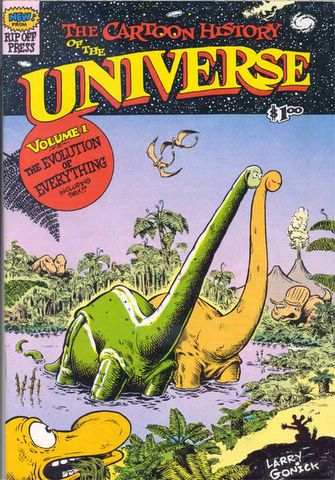
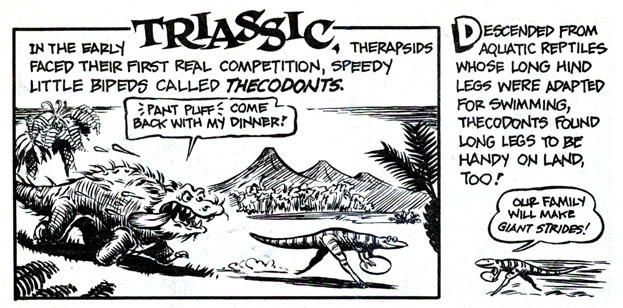
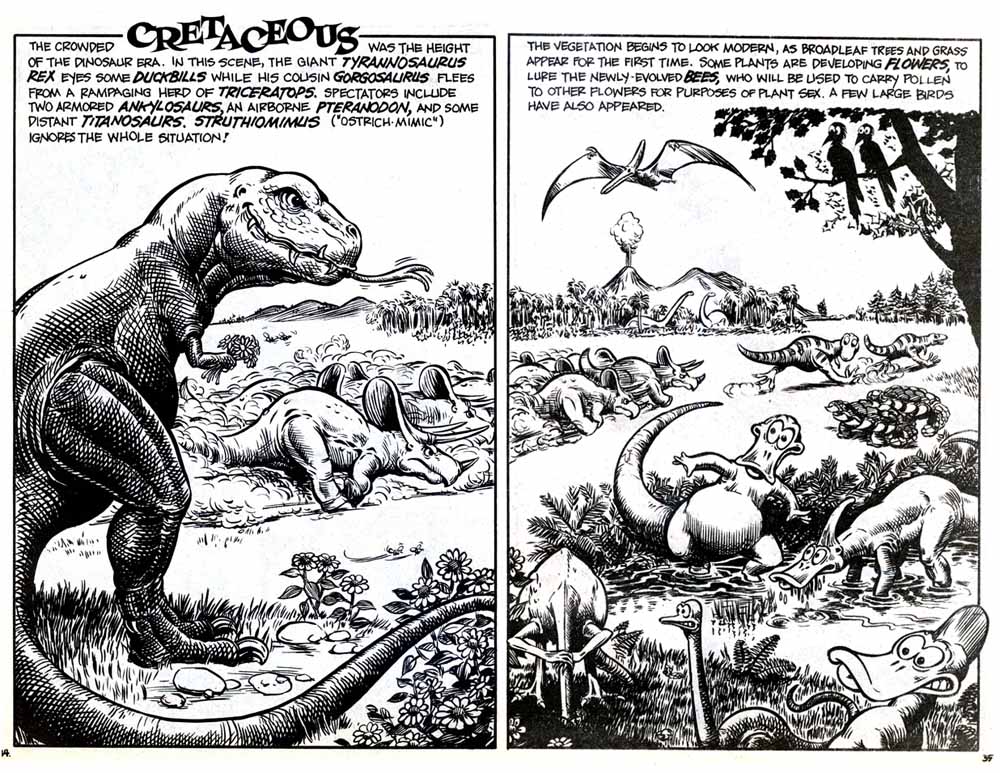
 The ‘science comic’ format was revamped completely by Harvard graduate and underground cartoonist Larry Gonick’s(right) inspired THE CARTOON HISTORY OF THE UNIVERSE (launched in 1978, from Rip Off Press). The irreverent first volume of Gonick’s delightful comic, “The Evolution of Everything (including Sex!!)” set the tenor for Gonick’s highly-entertaining, highly-informative approach to a once-static form, and dinosaurs figured prominently in that debut issue.

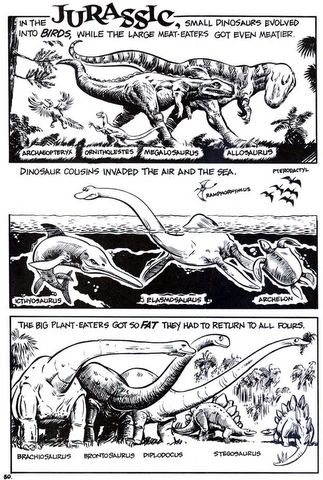
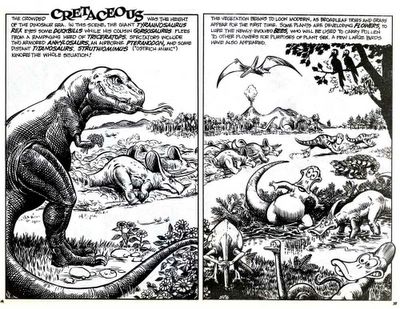

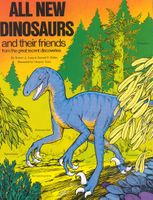
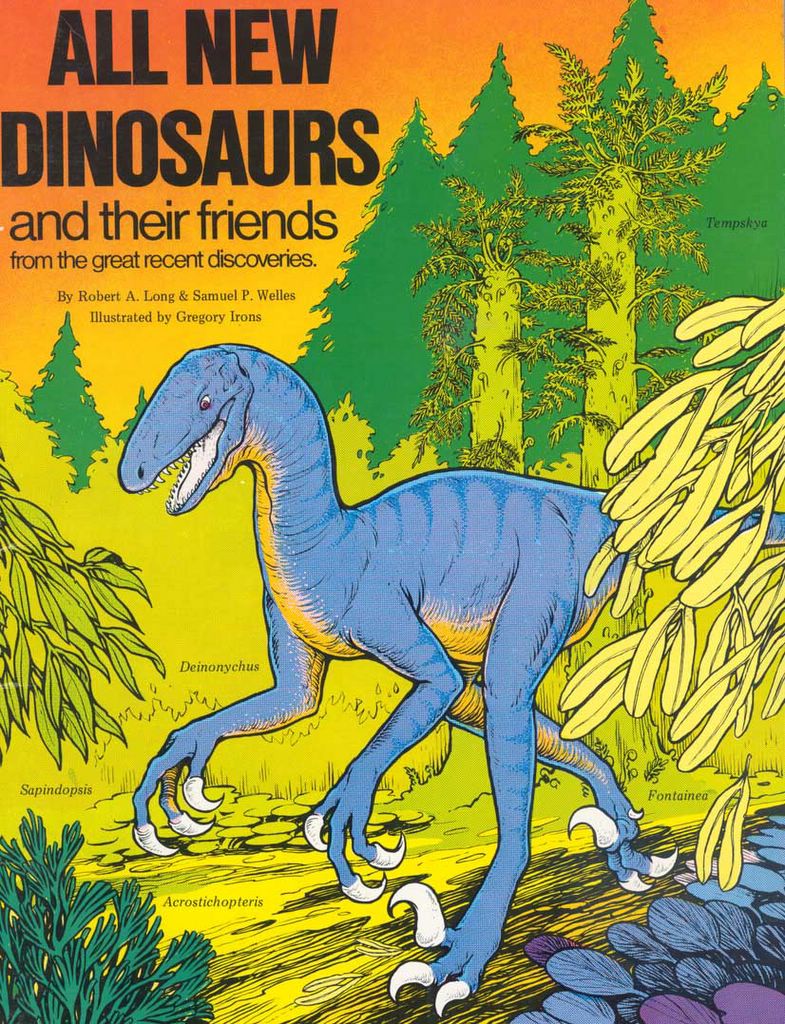
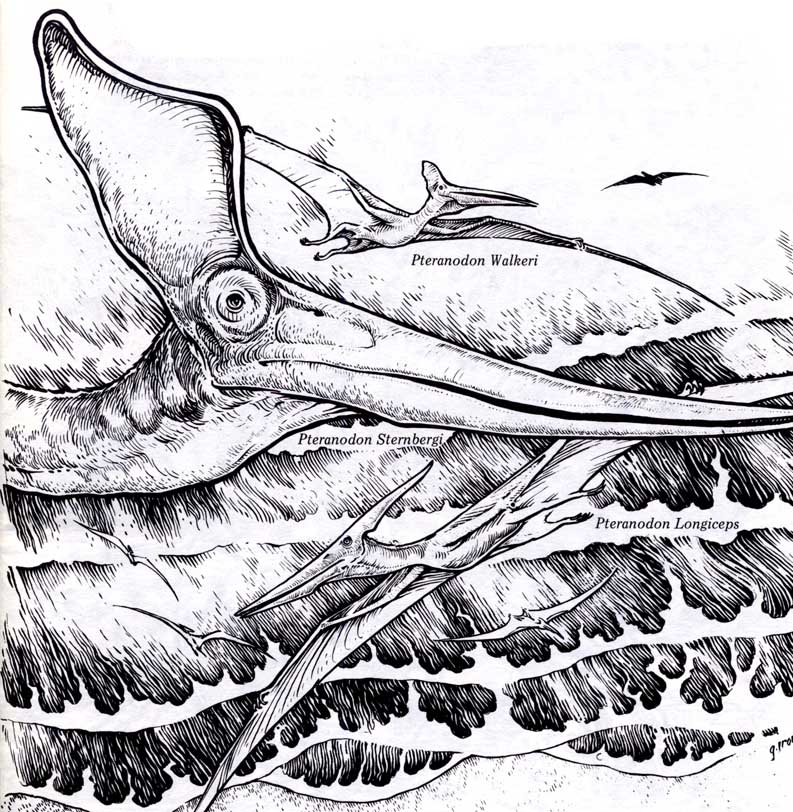
Fellow underground cartoonist Greg Irons raised the bar around the same time with his trio of coloring books for Bellerophon Press, particularly ALL NEW DINOSAURS AND THEIR FRIENDS and THE LAST OF THE DINOSAURS, which incorporated the radical revisionist thought and new discoveries in the science of paleontology.

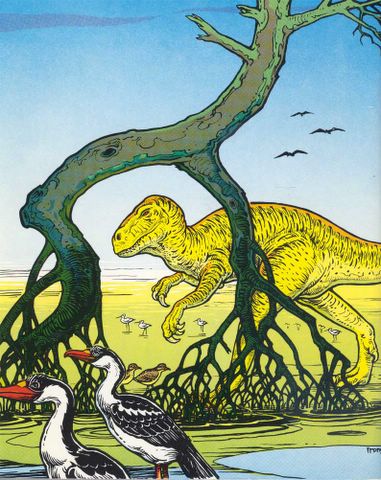
 These discoveries trickled into the pop culture, aided (and in part spearheaded) by a new generation of paleo artists. Prominent among these -- particularly in cartooning circles, in part because he emerged from the California-based ‘tribe’ -- was William Stout, whose book THE DINOSAURS: A FANTASTIC NEW VIEW OF A LOST ERA (with text by William Service; Byron Preiss/Bantam/Mallard, 1981) set a new high-water mark for the field. Stout’s showcase of exquisite dinosaur portraits and tableaus reached a much wider audience, inspiring a new wave of budding cartoonists. Still, my own hard experience in the comics field (since 1976) proved that editors and publishers were reluctant to indulge a ‘pure’ dinosaur comic: super heroes, time travel fantasies, ‘lost worlds,’ and city-stomping resurrected saurians still held sway.

That all changed in the 1990s, as the growing popularity of pop science and science fiction books, magazines, TV shows, and movies featuring dinosaurs gained critical mass. You could smell the blood in the air: the pop-cultural cycle had turned anew. Dinosaurs were ‘in,’ and those of us who grew up aching to draw our own dinosaur comics could wait no longer. The wave swelled to tsunami proportions with the publication of Michael Crichton’s novel JURASSIC PARK (1990, Knopf), and only gained momentum thereafter... and comics creators, editors, and publishers climbed their surfboards to catch the wave, too.
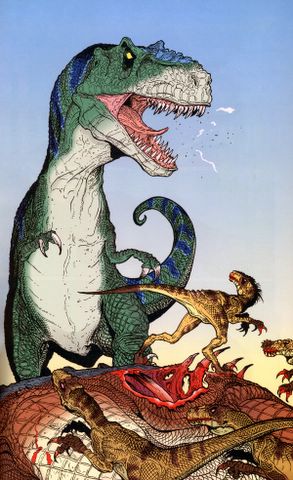
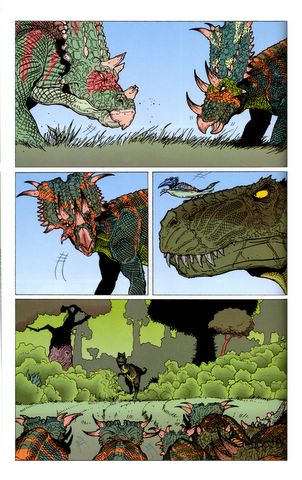
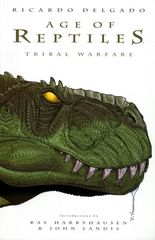
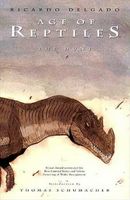 In 1989, Dark Horse Comics announced DINOSAUR: THE RULING REPTILES from writer Tim Sullivan and artist Mike Manley; alas, it was not to be, supplanted five years later by Ricardo Delgado’s delirious, phantasmagoric full-color AGE OF REPTILES (1993-94), a textless narrative brimming with movement, action, and (of course) dinosaurs. Delgado’s mini-series proved successful enough to spawn an even more expansive sequel, AGE OF REPTILES: THE HUNT (1996).
 In the meantime, other publishers mounted their own ‘pure’ dinosaur comics: under their imprint “Tome Press,” the ‘never-miss-a-wave’ folks at Caliber Press rushed out the two-issue DINOSAURS: AN ILLUSTRATED GUIDE (Winter, 1991; collected edition published 1997) by Charles Yates, an unsophisticated variant composed of single-page and panel snapshots of various prehistoric species accompanied by captions of descriptive text, peppered with occasional pages of non-sequitor sequential action. More ambitious (and better financed) was Marvel Comics’ Epic mini-series DINOSAURS: A CELEBRATION (1992-93)(below), conceived and helmed by editor Steve White as a collective of self-standing comic narratives by a variety of writers and artists, grounded in the most current paleontological science available.

For my own part, I completed work on the first issue of TYRANT, and debuted that sadly short-lived self-published venture in 1994.
These descendants of Newman and Maxon’s “Young Earth” bred and fled quickly; as the comics industry implosion of the late 1990s rocked the field, only the fittest survived.
Next Week: Part 9 - Jim Lawson's PALEO!.
Read Part 7 of the series by clicking HERE.
Thanks to Chad of the Digital Dream Machine Blog for a bunch of great scans.
All art and properties are (C) their creators and/or current copyright holders.
Steve R. Bissette is an artist, writer and film historian who lives in Vermont. He is noted for, amongst many things, his long run as illustrator of SWAMP THING for DC Comics in the 1980's and for self-publishing the acclaimed horror anthology TABOO and a 'real' dinosaur comic TYRANT(R).
This Week - Up From The Underground :
 The ‘science comic’ format was revamped completely by Harvard graduate and underground cartoonist Larry Gonick’s(right) inspired THE CARTOON HISTORY OF THE UNIVERSE (launched in 1978, from Rip Off Press). The irreverent first volume of Gonick’s delightful comic, “The Evolution of Everything (including Sex!!)” set the tenor for Gonick’s highly-entertaining, highly-informative approach to a once-static form, and dinosaurs figured prominently in that debut issue.


Fellow underground cartoonist Greg Irons raised the bar around the same time with his trio of coloring books for Bellerophon Press, particularly ALL NEW DINOSAURS AND THEIR FRIENDS and THE LAST OF THE DINOSAURS, which incorporated the radical revisionist thought and new discoveries in the science of paleontology.
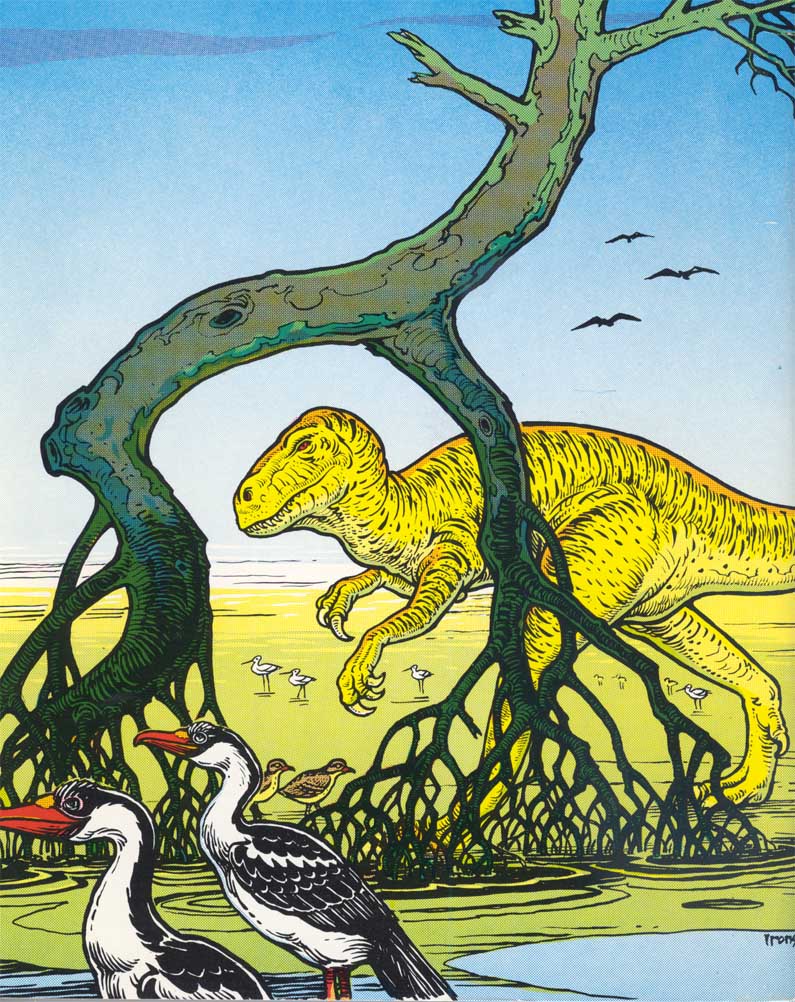
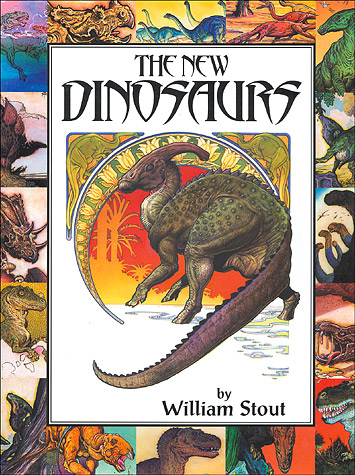 These discoveries trickled into the pop culture, aided (and in part spearheaded) by a new generation of paleo artists. Prominent among these -- particularly in cartooning circles, in part because he emerged from the California-based ‘tribe’ -- was William Stout, whose book THE DINOSAURS: A FANTASTIC NEW VIEW OF A LOST ERA (with text by William Service; Byron Preiss/Bantam/Mallard, 1981) set a new high-water mark for the field. Stout’s showcase of exquisite dinosaur portraits and tableaus reached a much wider audience, inspiring a new wave of budding cartoonists. Still, my own hard experience in the comics field (since 1976) proved that editors and publishers were reluctant to indulge a ‘pure’ dinosaur comic: super heroes, time travel fantasies, ‘lost worlds,’ and city-stomping resurrected saurians still held sway.
That all changed in the 1990s, as the growing popularity of pop science and science fiction books, magazines, TV shows, and movies featuring dinosaurs gained critical mass. You could smell the blood in the air: the pop-cultural cycle had turned anew. Dinosaurs were ‘in,’ and those of us who grew up aching to draw our own dinosaur comics could wait no longer. The wave swelled to tsunami proportions with the publication of Michael Crichton’s novel JURASSIC PARK (1990, Knopf), and only gained momentum thereafter... and comics creators, editors, and publishers climbed their surfboards to catch the wave, too.
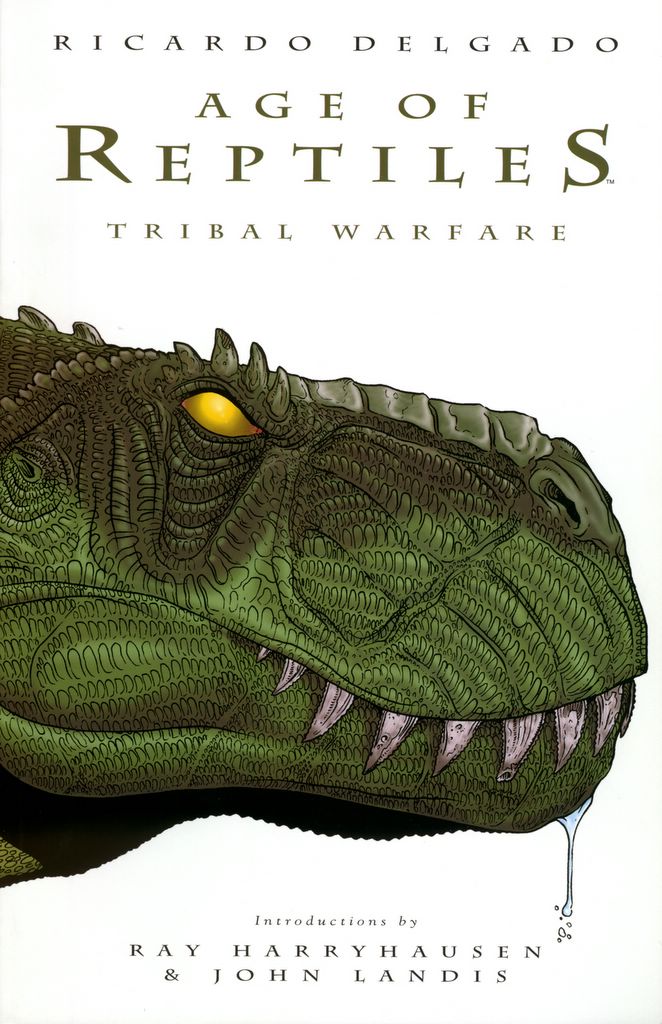
 In 1989, Dark Horse Comics announced DINOSAUR: THE RULING REPTILES from writer Tim Sullivan and artist Mike Manley; alas, it was not to be, supplanted five years later by Ricardo Delgado’s delirious, phantasmagoric full-color AGE OF REPTILES (1993-94), a textless narrative brimming with movement, action, and (of course) dinosaurs. Delgado’s mini-series proved successful enough to spawn an even more expansive sequel, AGE OF REPTILES: THE HUNT (1996).

 In the meantime, other publishers mounted their own ‘pure’ dinosaur comics: under their imprint “Tome Press,” the ‘never-miss-a-wave’ folks at Caliber Press rushed out the two-issue DINOSAURS: AN ILLUSTRATED GUIDE (Winter, 1991; collected edition published 1997) by Charles Yates, an unsophisticated variant composed of single-page and panel snapshots of various prehistoric species accompanied by captions of descriptive text, peppered with occasional pages of non-sequitor sequential action. More ambitious (and better financed) was Marvel Comics’ Epic mini-series DINOSAURS: A CELEBRATION (1992-93)(below), conceived and helmed by editor Steve White as a collective of self-standing comic narratives by a variety of writers and artists, grounded in the most current paleontological science available.
For my own part, I completed work on the first issue of TYRANT, and debuted that sadly short-lived self-published venture in 1994.
These descendants of Newman and Maxon’s “Young Earth” bred and fled quickly; as the comics industry implosion of the late 1990s rocked the field, only the fittest survived.
Next Week: Part 9 - Jim Lawson's PALEO!.
Read Part 7 of the series by clicking HERE.
Thanks to Chad of the Digital Dream Machine Blog for a bunch of great scans.
All art and properties are (C) their creators and/or current copyright holders.
Steve R. Bissette is an artist, writer and film historian who lives in Vermont. He is noted for, amongst many things, his long run as illustrator of SWAMP THING for DC Comics in the 1980's and for self-publishing the acclaimed horror anthology TABOO and a 'real' dinosaur comic TYRANT(R).
Cheap Dino Books
The are many excellent sources for obtaining books to build up ones personal library on paleontology. Your local independently-owned and run bookstore will be more then happy to help you track down titles that they do not have in stock.
Another excellent source on the web is EdwardRHamilton.com who specializes in selling overstock and remaindered books at very low prices. At any given time they have 1000’s of books available in over 100 different categories including Paleontology & Evolution. Books on Dinosaurs can also be found under the heading of Animals.
Titles currently available include:
THE DRAGON SEEKERS: How an Extraordinary Circle of Fossilists Discovered the Dinosaurs and Paved the Way for Darwin by Christopher McGowan,
DINOSAUR TRACKS AND OTHER FOSSIL FOOTPRINTS OF THE WESTERN UNITED STATES by M. Lockley & A.P. Hunt, and,
EXTINCTION AND PHYLOGENY edited By M.J. Novacek & Q.D. Wheeler.
Note that EdwardRhamilton.com will only ship within the USA.
FYI, “Steve Bissette’s History of Dino-Comics, Part 8” will be up later today -- I’m busy with work right now.
Another excellent source on the web is EdwardRHamilton.com who specializes in selling overstock and remaindered books at very low prices. At any given time they have 1000’s of books available in over 100 different categories including Paleontology & Evolution. Books on Dinosaurs can also be found under the heading of Animals.
Titles currently available include:
THE DRAGON SEEKERS: How an Extraordinary Circle of Fossilists Discovered the Dinosaurs and Paved the Way for Darwin by Christopher McGowan,
DINOSAUR TRACKS AND OTHER FOSSIL FOOTPRINTS OF THE WESTERN UNITED STATES by M. Lockley & A.P. Hunt, and,
EXTINCTION AND PHYLOGENY edited By M.J. Novacek & Q.D. Wheeler.
Note that EdwardRhamilton.com will only ship within the USA.
FYI, “Steve Bissette’s History of Dino-Comics, Part 8” will be up later today -- I’m busy with work right now.
Thursday, May 05, 2005
Hey Kids! Free Dinosaurs!
May 7th is Free Comic Book Day. Your local participating Comic Shop will be giving away free sample comics from a number of publishers. One that will be of interest to readers of the Palaeoblog will be this:
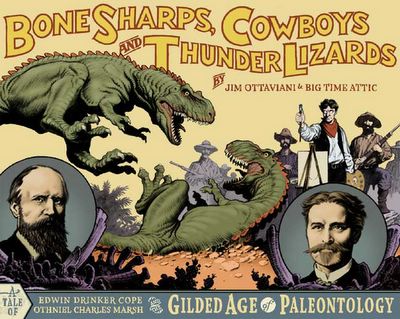
Click on image to enlarge.
The full edition of “BONE SHARPS, COWBOYS, AND THUNDER LIZARDS”, a 160 page original graphic novel about the most famous feud in fossil history -- The Marsh & Cope War -- featuring a cover by Mark Schultz (Xenozoic Tales) will be out this Fall...but if you head to a comic book store for Free Comic Book Day on May 7, you'll be able to pick up the special preview!.
Sharp-eyed readers will notice that that's Charles Knight on the cover creating one of his most famous dinosaur paintings.
Note that this is NOT the new Mark Schultz art book that I mentioned in a previous post -- info on that will be posted in a few days. But with the chance to pick up a FREE copy of the this nifty new book with Mark’s great cover coming up in only a few days I did not want anyone to miss the chance to grab one.
Find a comic shop near you by clicking HERE
For more information on the graphic novel from GT Labs click HERE.

Click on image to enlarge.
The full edition of “BONE SHARPS, COWBOYS, AND THUNDER LIZARDS”, a 160 page original graphic novel about the most famous feud in fossil history -- The Marsh & Cope War -- featuring a cover by Mark Schultz (Xenozoic Tales) will be out this Fall...but if you head to a comic book store for Free Comic Book Day on May 7, you'll be able to pick up the special preview!.
Sharp-eyed readers will notice that that's Charles Knight on the cover creating one of his most famous dinosaur paintings.
Note that this is NOT the new Mark Schultz art book that I mentioned in a previous post -- info on that will be posted in a few days. But with the chance to pick up a FREE copy of the this nifty new book with Mark’s great cover coming up in only a few days I did not want anyone to miss the chance to grab one.
Find a comic shop near you by clicking HERE
For more information on the graphic novel from GT Labs click HERE.
Happy Birthday To: Elkanah Billings
May 5, 1820 - June 14, 1896
From Today In Science History:
 Billings was a Canadian geologist and paleontologist, who was the first Canadian paleontologist. For three years as the editor of the Ottawa Citizen, he wrote a series of articles on science, including geology and paleontology. He published his first scientific paper on Trenton fossils in 1854. He launched a new monthly periodical, The Canadian Naturalist and Geologist in 1856, which he also edited and was the major contributor. In Aug 1856 he was appointed staff paleontologist with the Canadian Geological Survey by William Edmond Logan, the founder of the Survey. Billings immediately began the task of identifying a 20-year backlog of fossils collected by the Survey. By 1863 he had published descriptions of no fewer than 526 new species of fossils.
The Billings medal, named in his honour, is awarded annually by the
Paleontology Division of the Geological Association of Canada as a means of recognizing the most outstanding of its paleontologists, those, who through unique and/or sustained contributions, have brought recognition to the science of paleontology in this country.
However, the working habits of some palaeontologists don't always mesh with those of their bosses, to wit:
For more info on Billings click HERE.
Click HERE for more information on the Geological Association of Canada.
Portrait of Elkanah Billings GSC photo 69323 (c)
From Today In Science History:
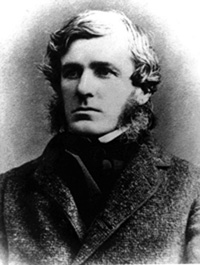 Billings was a Canadian geologist and paleontologist, who was the first Canadian paleontologist. For three years as the editor of the Ottawa Citizen, he wrote a series of articles on science, including geology and paleontology. He published his first scientific paper on Trenton fossils in 1854. He launched a new monthly periodical, The Canadian Naturalist and Geologist in 1856, which he also edited and was the major contributor. In Aug 1856 he was appointed staff paleontologist with the Canadian Geological Survey by William Edmond Logan, the founder of the Survey. Billings immediately began the task of identifying a 20-year backlog of fossils collected by the Survey. By 1863 he had published descriptions of no fewer than 526 new species of fossils.
The Billings medal, named in his honour, is awarded annually by the
Paleontology Division of the Geological Association of Canada as a means of recognizing the most outstanding of its paleontologists, those, who through unique and/or sustained contributions, have brought recognition to the science of paleontology in this country.
However, the working habits of some palaeontologists don't always mesh with those of their bosses, to wit:
On April 27, 1869, the Director of the GSC, Sir William Logan wrote this curt note to the paleontologist Elkanah Billings: "Your constant absence from the office is a worrying annoyance, particularly as I have reason to suspect that it does not arrive from rheumatism".Growing up in Ottawa the Billings Estate was close to my home. During my undergraduate days I would walk by the estate everyday on my way to school.
For more info on Billings click HERE.
Click HERE for more information on the Geological Association of Canada.
Portrait of Elkanah Billings GSC photo 69323 (c)
Wednesday, May 04, 2005
New Therizinosauroid Found In Utah
A primitive therizinosauroid dinosaur from the Early Cretaceous of Utah. James I. Kirkland, Lindsay E. Zanno, Scott D. Sampson, James M. Clark and Donald D. DeBlieux. 2005. Nature 435: 84-87.
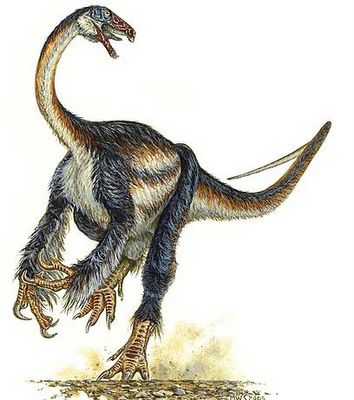
Painting by Michael Skrepnick.
From National Geographic News.com:
The 125-million-year-old fossils, from the dinosaur Falcarius utahensis, were discovered in a graveyard of hundreds, if not thousands, of individuals. Though it may have eaten meat, Falcarius's teeth and guts show the first signs of the species's change toward a leafy, green diet, said James Kirkland, a paleontologist at the Utah Geological Survey in Salt Lake City.
"We can see definitive features of eating plants and know its descendents were much more full-time plant-eaters," Kirkland said.
The newly discovered creature was likely cloaked in hairlike feathers and walked on two legs. Adults measured about 13 feet (4 meters) long, head to tail. They stood about 4.5 feet (1.4 meters) tall and had sharp, curved, 4-inch-long (10-centimeter-long) claws. Falcarius was a member of the therizinosaurs. These feathered dinosaurs with birdlike hips are considered among the weirdest ever discovered. Falcarius, Zanno added, is the most primitive therizinosaur yet discovered and unequivocally demonstrates that the group evolved from Velociraptor-like ancestors.
The Falcarius fossils show this transition in action among a group of dinosaurs, the birdlike meat-eating dinosaurs of the late Cretaceous period (about 140 million years ago). The finding allows paleontologists insight into long-nagging questions of evolution.
Thomas Holtz is a paleontologist at the University of Maryland in College Park. He said the Falcarius fossils are a clearer window into the shift from meat eating to plant eating than is available for equivalent transitions within other dinosaur groups. Prior to the Falcarius discovery, the likely intermediate forms between meat eaters and plant eaters "are either not yet discovered or are very fragmentary and so not recognized as such," Holtz said. That's what makes Falcarius so rare.
Read the rest of the story HERE.
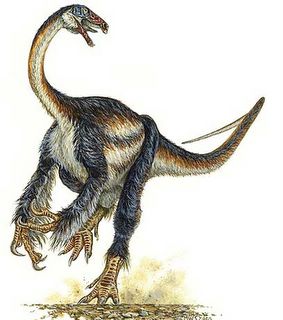
Painting by Michael Skrepnick.
From National Geographic News.com:
The 125-million-year-old fossils, from the dinosaur Falcarius utahensis, were discovered in a graveyard of hundreds, if not thousands, of individuals. Though it may have eaten meat, Falcarius's teeth and guts show the first signs of the species's change toward a leafy, green diet, said James Kirkland, a paleontologist at the Utah Geological Survey in Salt Lake City.
"We can see definitive features of eating plants and know its descendents were much more full-time plant-eaters," Kirkland said.
The newly discovered creature was likely cloaked in hairlike feathers and walked on two legs. Adults measured about 13 feet (4 meters) long, head to tail. They stood about 4.5 feet (1.4 meters) tall and had sharp, curved, 4-inch-long (10-centimeter-long) claws. Falcarius was a member of the therizinosaurs. These feathered dinosaurs with birdlike hips are considered among the weirdest ever discovered. Falcarius, Zanno added, is the most primitive therizinosaur yet discovered and unequivocally demonstrates that the group evolved from Velociraptor-like ancestors.
The Falcarius fossils show this transition in action among a group of dinosaurs, the birdlike meat-eating dinosaurs of the late Cretaceous period (about 140 million years ago). The finding allows paleontologists insight into long-nagging questions of evolution.
Thomas Holtz is a paleontologist at the University of Maryland in College Park. He said the Falcarius fossils are a clearer window into the shift from meat eating to plant eating than is available for equivalent transitions within other dinosaur groups. Prior to the Falcarius discovery, the likely intermediate forms between meat eaters and plant eaters "are either not yet discovered or are very fragmentary and so not recognized as such," Holtz said. That's what makes Falcarius so rare.
Read the rest of the story HERE.
New Mark Schultz Art Book Teaser

Mark Schultz recently sent along the wrap-around cover and some selected images from his soon-to-be-published new art book. The book is designed by the award-winning designer Randy Dahlk, and features LOTS of unseen art including dozens of beautiful finished drawings, sketches, and lots of surprizes. Over the next week I'll be posting the art that Mark sent me as well as info on how and where you'll be able to buy this fabulous book. For now, this teaser detail from the back cover will have to do!
Subscribe to:
Posts (Atom)